UC Tech News is excited to share the stories of the people and projects behind the winners of the 2026 UC Tech Awards.
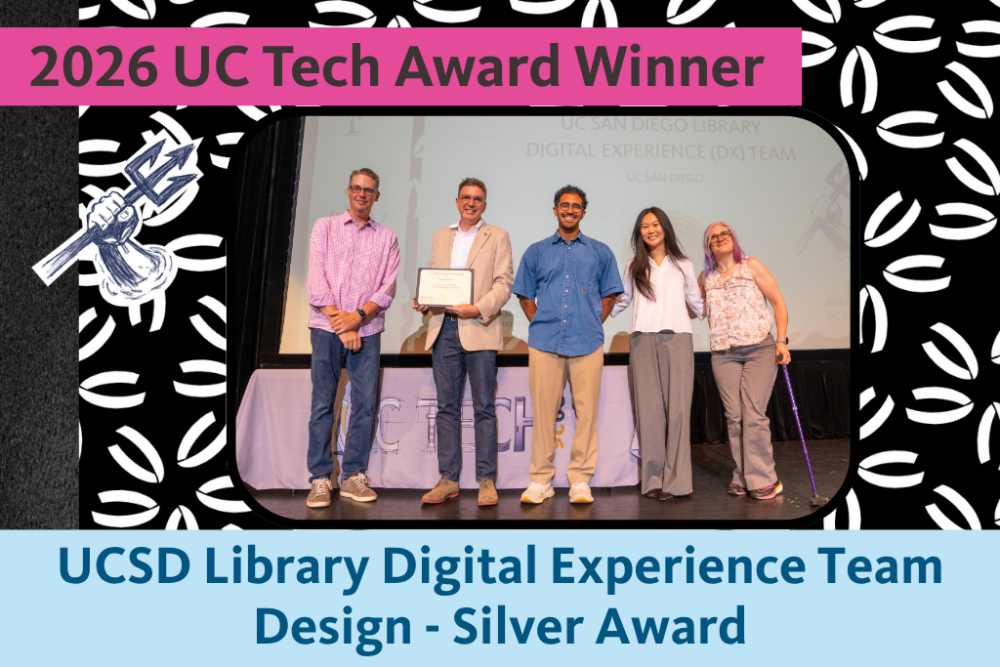
Team Name: UC San Diego Library Digital Experience (DX) Team
Award Category: Design
Location: UC San Diego Library
Team Members:
- Doug Worsham, Digital Experience Manager, UC San Diego Library
- Jenn Dandle, Web Manager, UC San Diego Library
- Greg Ferguson, ILS Manager, UC San Diego Library
- Chris Lopez, Design Engineer, UC San Diego Library
- Hannah Yick, Digital Product Strategist, UC San Diego Library
The UC San Diego Library Digital Experience (DX) Team won the Silver Design Award at the 2026 UC Tech Awards for creating a sustainable, library-wide practice for user-centered design that transformed how accessibility and quality assurance are managed across the Library’s core public website.
Project Summary
The UC San Diego Library’s core public website serves 1.2 million unique visitors each year, from students and faculty to researchers and community members. Over time, the website had accumulated thousands of quality and accessibility issues.
With a small team, limited time, and a backlog of issues, the DX team set out to create a sustainable, team-based practice for user-centered, inclusive design. They implemented several library-wide organizational change initiatives:
- Student Design Team: A paid employment program that brings students into active design projects, providing meaningful hands-on experience and mentorship while expanding the team’s capacity to deliver user-centered work.
- Website Committee: A monthly quality and accessibility review that brings the DX team and Library’s content leads together to identify website improvements and build a shared accountability structure.
- Design Process Playbook: A living document that provides the DX team with inclusive design methods, guiding work from discovery through launch and authentic engagement with users.
- Open Design Jam: A quarterly co-design session that integrates Library users directly into the design process, using their real-time feedback and perspectives to inform the DX team’s priorities and decisions.
These initiatives put user experience at the forefront and made essential Library content more accessible to all users. The DX team transformed quality assurance and accessibility from a series of one-time fixes into a sustainable, library-wide culture of collaboration, shared responsibility, and continuous improvement.
Doug Worsham, the team representative, shared some of his thoughts on the project and its impact in the Q&A below.
How did collaboration across teams or campuses shape the project?
One of the questions our team works on together all the time is: What kinds of collaboration make accessible and inclusive design sustainable over time?
The Student Design Team was built around the idea that student designers would closely collaborate with full-time staff on real projects.
The first cohort started by reflecting on their own design values and then co-developing the Student Design Team Manifesto together. The values from that first manifesto drive our work to this day.
“For example, one of the manifesto’s values is “Champion creativity and innovation.” In alignment with UC San Diego Library values, we celebrate creativity, risk-taking, and exploration. Collaborating with our team and community introduces new perspectives and inspires ideas that expand the boundaries of our work. We find joy and excitement in the creative process, taking on diverse projects that grow our personal frameworks and developing solutions that positively impact the larger UC San Diego community.'”
Then, we built structures to put our shared values into daily practice. We call these our “ways of working.” They include shift check-ins, communication norms that make collaboration possible across a hybrid team, and the three-step apprenticeship model at the heart of how we develop designers together: (1) Here, watch how I do this. (2) Now you try, and I’ll be here to help. (3) What did you notice? Are you ready to do that on your own? What would you change?
“One of our ways of working is called “no lonely shifts.” That means every shift should have a “hello,” a “please,” a “thank you,” and a “goodbye.” We’re creating structures which build that culture of working, which in turn makes it so that we can all collaborate well together.”
We built structures for collaboration across the Library as well. When we formed the Website Committee, we followed the same values-driven process to define our Foundational Standards for Library Public Websites. Then we established monthly reviews of Siteimprove data that help us have real conversations about what’s happening and what could be improved with our websites.
Both the apprenticeship model and the Website Committee are expressions of the same belief that values have a bigger impact when you build structures to support them.
What did winning this UC Tech Award mean to your team personally or professionally?
Our full-time staff and our student designers, current and former, put real effort into this, and it is wonderful to get to share this moment with them. We sustained accessibility scores for our core website above the industry benchmark in 35 of 37 monthly measurements over three years. During that time, scores fluctuated and individual issues got resolved as new ones appeared.
Winning an award that recognizes sustained performance over time feels special. I love the idea that this ongoing, team-based, and genuinely “never finished” kind of work is considered and celebrated for awards like this. I think it recognizes the ways in which so much work happens in a slow and sustained way, and that progress comes through ongoing care and craft.
What did you learn from this experience that you can share with other UC teams?
The first takeaway is that sustained quality requires both shared values and structural solutions that put those values into practice. Everyone needs structures that support individual and team-based craft and creative processes.
If you haven’t done it already, every team can start with the values you already hold, write them down together, and then ask: What meeting pattern, what recurring practice, what communication norm would express and strengthen those values in daily work?
Another takeaway is that teams can hire students into real work and co-create team values and practices with them. The learning travels in both directions.
“We have an email list going, where we share our community events, job opportunities, and a glimpse into the job. The Student Design Team creates a little slideshow about what they do and what they like about what they do. People who are interested in the job can get this first-hand look from their peers about what it’s like to have the job. This leads to interest in the job and allows us to stay engaged with a growing community.”
During interview rounds, we ask very experiential, scenario-based questions: What would you do in a situation like this? Walk us through this. Show us how you would approach this challenge? We’ll have a large pool of candidates with technical skills, so we found that the most successful students are those who bring qualities like ambiguity tolerance, love of iteration, ability to receive feedback, desire to ask questions, and service orientation.
So far, we’ve had sixteen early-career designers come through our team. They’ve gone on to UX and design roles, carrying inclusive design and accessibility practices with them. In some ways, the biggest impact of the work we do together will happen out there in the world, when our student employees graduate and bring their experiences with them.
Contact
Doug Worsham, Digital Experience Manager, UC San Diego Library