In summer 2028, the world will turn its attention to Los Angeles for the Olympic and Paralympic Games. At UCLA, that will mean welcoming thousands of athletes and support personnel from around the world and transforming a working university campus into the Olympic and Paralympic Village.
For fun, consider just a few numbers:
- About 15,000 athletes are expected to compete, with UCLA serving as the Olympic and Paralympic Village. When UCLA hosted athletes during the 1984 Games, that number was about 4,000.
- At the Village’s peak, UCLA expects to support around 17,000 athletes and members of their support teams.
- UCLA expects to serve roughly 42,000 meals a day.
- The Games are expected to feature more than 40 sports and approximately 800 events.
That’s an enormous influx of people, technology and activity.
Yet while all of that is happening, UCLA still has to be UCLA.
Research will continue. Patients will need care. Students and faculty still need technology. Campus operations keep moving. And at the same time, the university must prepare for the cybersecurity demands that come with hosting one of the world’s largest and most visible events.
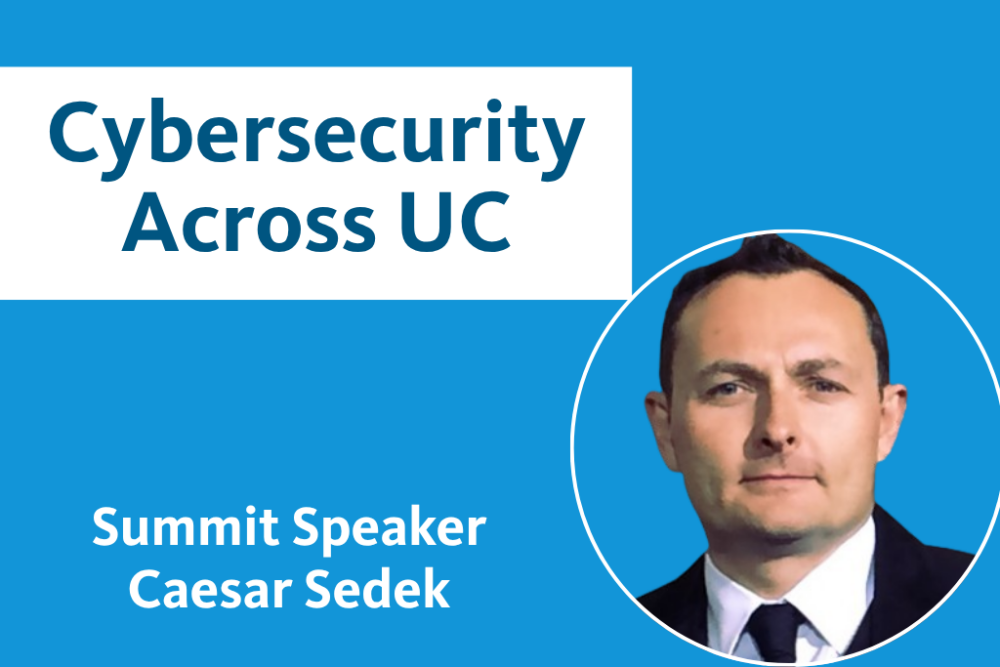
At the 2026 UC Cybersecurity Summit, Caesar Sedek, Assistant Chief Information Security Officer at UCLA, explored this challenge in his presentation on preparing UCLA for the 2028 Games. His message extended well beyond the Olympics: readiness depends on knowing your environment, building strong relationships and using a major event as an opportunity to create improvements that last.
#1 Know What You Have and Who Owns It
One of Sedek’s key lessons starts with a deceptively simple set of questions: Who owns the website? Who can make a change? And who has the authority to accept the risk if it isn’t changed?
Finding a technical vulnerability is one thing. Knowing who is responsible and has the authority to address it can be another. As Sedek put it in his presentation, “A technical finding becomes an ownership problem.”
Being ready for a high-profile event therefore requires more than finding vulnerabilities. Organizations need to understand what systems and assets they have, maintain accurate information about them and establish clear business, technical, executive and security responsibilities.
That preparation matters in everyday operations, but the stakes become even clearer when the eyes of the world are on your institution.
#2 Cybersecurity Readiness Is a Team Sport
The Olympics may have plenty of individual events, but cybersecurity readiness isn’t one of them.
Another major theme of Sedek’s presentation was the importance of relationships. His advice was straightforward: “Relationships begin before the urgent call.”
For UCLA, preparing for 2028 involves coordination that reaches far beyond the central security team. Networking, platform services, research, health, campus IT, communications, police, emergency management and university leaders all have roles to play, along with partners outside the university.
That means building connections and defining responsibilities before something goes wrong. During an incident, knowing who to call, who can make a decision and who has the authority to act can be as important as the technology itself.
The lesson applies far beyond the Games: cybersecurity is an organizational responsibility, and resilience depends on people who already know how to work together.
#3 Prepare for 2028, Strengthen the University
The Olympic and Paralympic Games create a firm deadline for UCLA, but Sedek emphasized that the work shouldn’t be viewed as temporary preparation for a single event. He described the Olympics as something that can accelerate existing problems, pushing organizations to address issues that already need attention.
The work being done now can strengthen asset management, clarify accountability, improve communication, test recovery capabilities and establish stronger working relationships. Long after the athletes have gone home, the kitchens have quieted after serving tens of thousands of meals a day and the campus has returned to its familiar rhythms, those improvements will remain.
The Games are an opportunity to use an extraordinary event to make the university stronger for the ordinary days that follow. As Sedek summed it up: “The Olympics are a deadline, but the objective is a stronger university that lasts long after the Closing Ceremony.”

Thank you to Caesar Sedek for an interesting and timely session! Read the entire 2026 Cybersecurity Summit Recap here!
Share YOUR Cybersecurity, Privacy, or Digital Risk Story!
Do you have a story, initiative, or project to share for the Cybersecurity Across UC series? Send us information, an outline, a story you have written, or even a published story that is relevant. We’d love to include it in this new series! Submit a UC Tech News blog intake form found here.
Questions? Email us at UCTechNews@ucop.edu.
UC Tech News Content Survey
Do you visit the UC Tech News site regularly and/or get the monthly newsletter? If so, please take our short content survey: https://survey.alchemer.com/s3/9080340/2026-UC-Tech-News-Content-Survey