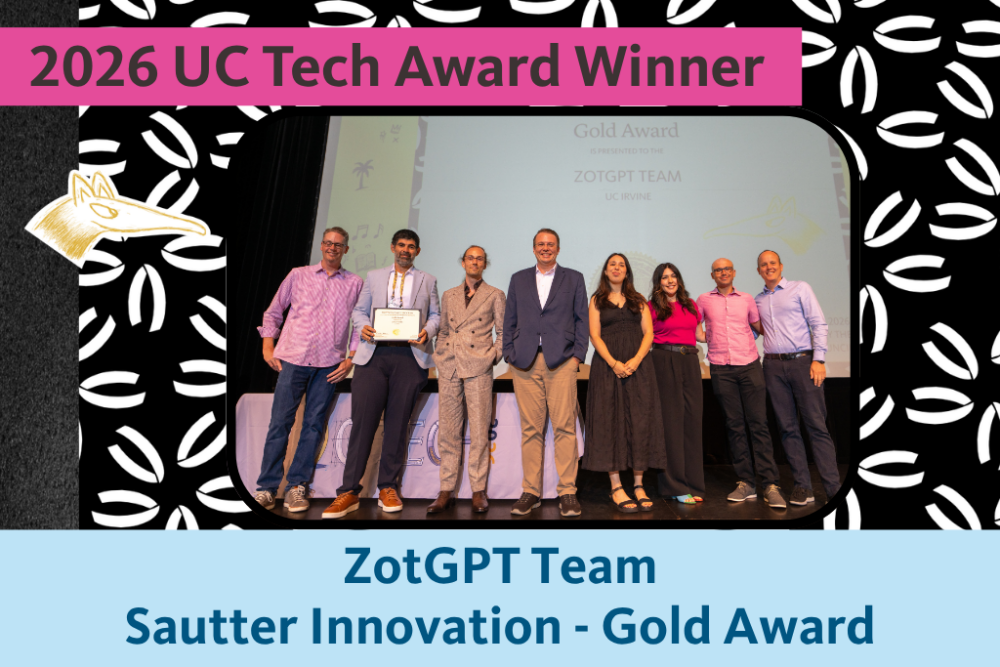
UC Tech News is excited to share the stories of the people and projects behind the winners of the 2026 UC Tech Awards.
Team Name: ZotGPT Team
Award Category: Larry L. Sautter for Innovation in IT
Location: UC Irvine
Team Members:
- Sarkis Daglian, Director of AI, Cloud & Client Solutions, OIT, UC Irvine
- Max Garrick, AI Product Manager, OIT, UC Irvine
- Chris Price, AI Architect & Lead AI Developer, OIT, UC Irvine
- Gary Arzumanyan, AI Developer, OIT, UC Irvine
- Dominic Slauson, Generative AI Specialist, OIT, UC Irvine
- Ray Vadnais, AI UX Lead, OIT, UC Irvine
- Jeff Picco, Security Engineer, OIT, UC Irvine
- Sylvia Bass, Web Content Architect, OIT, UC Irvine
- Xanat Hernandez, Communications Director, OIT, UC Irvine
- Kristen McIntyre, Communications Manager, OIT, UC Irvine
- Theresa Phan, Senior Digital Designer, OIT, UC Irvine
- Meredith Ehrenberg, Information Architect, OIT, UC Irvine
The ZotGPT Team won the Gold Larry L. Sautter for Innovation in IT Award at the 2026 UC Tech Awards for creating ZotGPT: a free, secure AI ecosystem for the UC Irvine campus community.
Project Summary
When generative AI rapidly entered higher education, UC Irvine faced a challenge shared by universities everywhere: how to embrace the technology while protecting privacy, maintaining academic integrity, and ensuring equitable access.
In response, the ZotGPT Team set out to build an AI ecosystem, now called ZotGPT, designed around the diverse needs of its entire campus community. In 2024, UC Irvine became the first UC campus to offer premium AI models at no cost, campus-wide. The ecosystem has since expanded to offer 40 AI models from Claude, OpenAI, and more.
Access was only the starting point. The team wanted every corner of campus to feel a sense of ownership over ZotGPT, so they actively engaged faculty, staff, and students to implement and innovate using its tools.
“More than 100 staff competed in a Build-a-Bot Workshop, building assistants for research, ADA compliance, and more. Cyber@UCI, a student-led security club, was recruited to adversarially test the platform, raising security standards while giving students real-world research experience.”
ZotGPT is built on four core products that now shape how the UC Irvine community works, teaches, and learns:
- ZotGPT Chat: A free, campus-wide AI chat platform with customized capabilities – a value of at least $50 a month per user.
- ClassChat: An AI tool for instructors to create chatbots fine-tuned on their own course materials – enabling a personalized learning experience.
- ZotGPT Creator: A no-code builder for departments and individuals to build customized AI assistants – replacing third-party solutions that would have cost over $10,000 each.
- ZotGPT Academy: Structured AI literacy training through 30-minute modules teaching foundational prompting skills and responsible use.
The AI ecosystem now counts over 30,000 unique users across the UC Irvine community, generating more than 200,000 chat messages per year. Its impact spans the classroom, daily operations, and research labs alike.
“In the classroom, ClassChat is enabling learning experiences that weren’t previously possible. UC Irvine Nursing professor Dawn Bounds built AI patient simulations that let students practice difficult clinical conversations repeatedly before entering real care settings.”
“In research, the ZotGPT API is helping researchers work faster and at a greater scale. A collaboration with the Langson Institute and Museum of California Art reduced art cataloging time from six months to a single overnight run, tagging over 3,000 images in hours.”
By making powerful AI tools accessible to everyone, building AI literacy, and empowering the campus community to develop their own solutions, ZotGPT has helped close the digital divide in AI access at UC Irvine. More importantly, it has laid a foundation for responsible AI adoption and become a powerful engine for innovation across teaching, research, and university operations.