UC Tech News launched the UC Tech Leaders Q&A Series in 2026—a series designed to spotlight the voices shaping technology across UC.
What is Your Name?
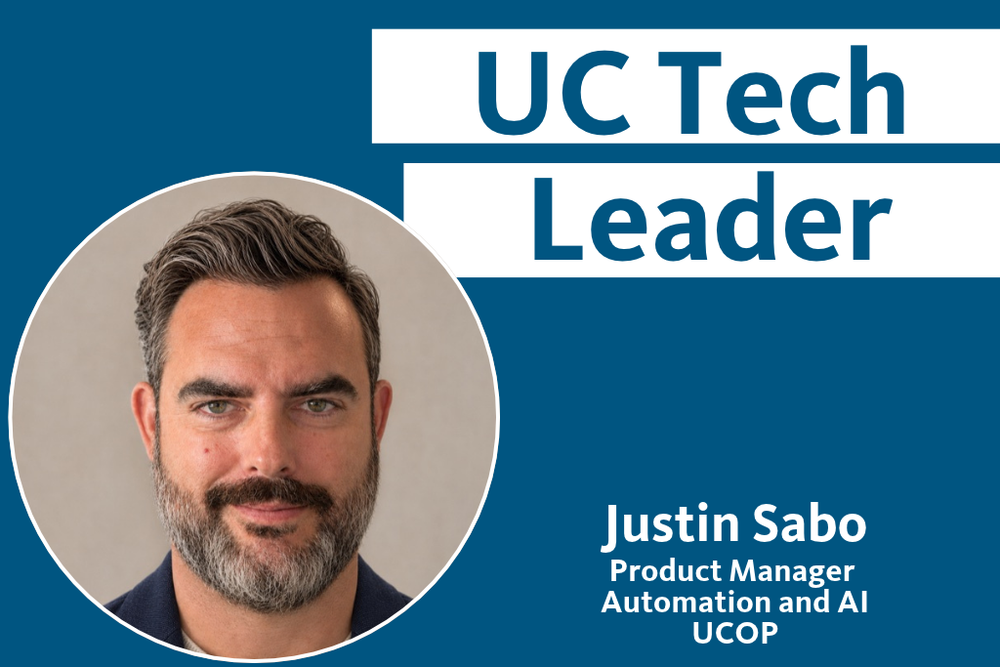
Justin Sabo
What is Your Title? UC Location?
Product Manager Automation and Artificial Intelligence, UC Office of the President (UCOP)
What are Your Top IT/Security Priorities in 2026?
My biggest priority is scaling AI adoption across UCOP in a way that’s responsible, secure, and delivers real value. That includes establishing practical guardrails for agentic AI, simplifying how teams request and get approval for AI solutions, and exploring how defensive AI can help strengthen cybersecurity operations, including threat detection and incident response. Equally important is making AI accessible to our workforce. We’re investing in AI literacy through our AI Community of Practice, AI Buddy Program, and Student AI Corps to help employees build confidence and put these tools to work. At the systemwide level, my goal in participating in the UC Systemwide IT AI Council is to collaborate with colleagues across campuses, share what we’re learning at UCOP, and learn from the work happening throughout the university. There’s tremendous expertise across UC, and I see real value in finding opportunities to align our efforts, build on each other’s successes, and avoid solving the same problems ten different times.
What Emerging Tech Excites You for Higher Ed?
What excites me most is the convergence of automation and artificial intelligence, particularly through agentic AI. Traditional automation has been great at handling repetitive, rules-based tasks, while AI has largely focused on understanding information, generating content, and supporting decisions. Agentic AI brings those capabilities together, allowing systems to reason through problems, coordinate tasks, interact with applications, and act across complex workflows. Higher education has an enormous amount of administrative complexity, and I think we’re just beginning to see what’s possible when these technologies work together. If we can responsibly automate processes like intake, document review, reporting, and routine service requests, we can give employees more time to focus on higher-value work and the people they serve. I’m also excited about AI’s potential to personalize education. Having an AI tutor or coach that adapts to how someone learns could fundamentally change how we approach both student learning and workforce development.
What Emerging Tech Worries You?
What concerns me most is how quickly AI capabilities are advancing relative to our ability to understand and govern their risks. Agentic AI introduces new challenges when systems can independently make decisions, access sensitive information, interact with applications, and act with limited human oversight. Looking beyond higher education, I’m particularly interested in, and somewhat concerned about AI swarms and autonomous robotic systems. The technology itself isn’t inherently good or bad, but the idea of multiple intelligent, persistent agents working together toward a common goal, whether beneficial or harmful, is incredibly powerful. The potential is enormous, but so are the implications if these systems are used irresponsibly or without appropriate safeguards. I don’t believe the answer is to slow innovation to a crawl. We need to develop responsible governance alongside the technology and make the secure, approved path the easiest one to follow.
How Do You Balance Innovation with Security?
I don’t see innovation and security as competing priorities. Security isn’t an obstacle to innovation; it’s what allows us to innovate responsibly and at scale. In fact, some of the most exciting innovations happening right now are in cybersecurity itself, particularly how AI can help us identify threats, strengthen defenses, and respond more effectively. We try to bring our security, privacy, and legal partners into conversations early rather than treating their reviews as the final step. That helps us establish clear expectations around data classification, access controls, human oversight, and accountability before solutions are deployed. I’m a big believer in starting small, testing assumptions, measuring results, and expanding what works. Not every experiment needs to become an enterprise solution, but every experiment should teach us something.
What Principles/Values Shape Your Leadership?
Service. It’s the one principle that’s been consistent throughout my life, from my first job as a lifeguard to my time in the Marine Corps, my nonprofit work with the Compassion Heals Movement, and now my work with the University of California. I’ve always believed in being of service to others, and I’ve found that much of my own success has come from helping others succeed. I’ve learned that leadership isn’t about having all the answers or being the most talented person in the room. It’s about bringing together people with the right skills, experiences, and perspectives to accomplish something greater than any one person could achieve alone. I think that’s also what makes the University of California special. Unlike organizations where much of the value is tied to a product, UC’s greatest strength is its people and the collective knowledge and experience across our campuses and the broader system. One of my mentors taught me something that’s always stuck with me: “If you want to go fast, go alone. If you want to go far, go together.” I believe there’s tremendous power in that idea, particularly at UC. Only by aligning our talents and pulling in the same direction toward a shared goal can we truly achieve something great.
What Books are You Currently Reading?
Be Useful: Seven Tools for Life by Arnold Schwarzenegger and Letters from an Astrophysicist by Neil deGrasse Tyson.
What’s Your Favorite Thing to Do Outside of Work?
These days, most of my free time revolves around my growing family. I have a young son and another little one on the way, so life outside of work is pretty busy. There isn’t much downtime, but I’ve always loved reading and movies, especially science fiction and fantasy. There’s something magical about getting to live a thousand different lives through stories, whether you’re a swashbuckling pirate, hurtling through the void on a spaceship, or setting off on an epic quest. I’ve always wanted to be a professor, and in some ways, raising children feels like the ultimate teaching opportunity. I’m looking forward to sharing those adventures with my kids, encouraging their imaginations, and getting to experience that sense of wonder all over again through their eyes.
Is there anything else you’d like to add?
One thing I’ve been thinking about lately is the three I’s: innovation, invention, and imitation. We tend to focus on AI’s potential to create something entirely new, but I think there’s tremendous value in all three. Innovation is about improving how we do things, invention is about creating something that didn’t exist before, and imitation is about learning from what’s already working and adapting it to our own needs. I’m excited to see how AI can accelerate each of these, particularly across the University of California. We don’t always need to reinvent the wheel. Sometimes the greatest opportunity is taking a good idea from one part of the university, adapting it, and making it available to others. Other times, we have an opportunity to build something entirely new. I think the real potential lies in recognizing when each approach makes sense and being willing to learn from one another.
Thank you for the great conversation, Justin!

Justin Sabo
Product Manager Automation and Artificial Intelligence
UCOP
Tech Leader Spotlights
UC Tech News launched the UC Tech Leaders Q&A Series in 2026—designed to spotlight the voices shaping technology across UC. The UC tech community values hearing directly from its leaders, and this series aims to be both inspiring and informative.
Do you want to nominate our next UC Tech Leader? Email us at UCTechNews@ucop.edu.
Are you a tech leader at UC? We’d love to hear from you! To participate, please complete the short Q&A form and please include a photo.