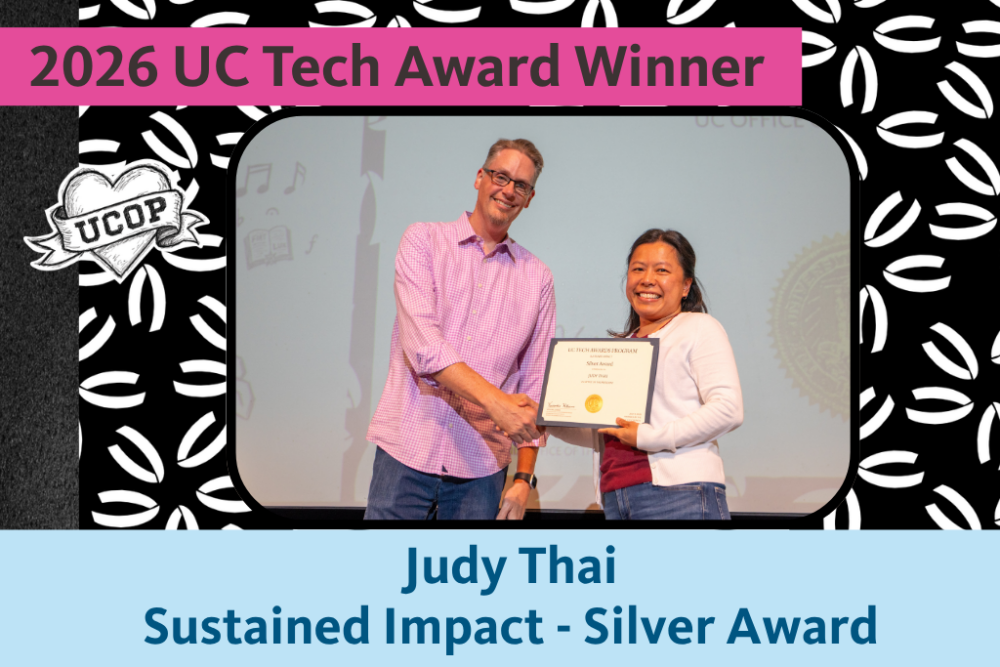
UC Tech News is excited to share the stories of the people and projects behind the winners of the 2026 UC Tech Awards.
Name: Judy Thai
Award Category: Sustained Impact
Location: UCOP
Judy Thai has advanced digital accessibility at UCOP and across UC by developing practical guidelines, shaping policy, and embedding equity into procurement and operations. Her collaborative leadership and mentorship have built lasting capacity and a culture of inclusive, systemwide impact.
Summary
The university faced a growing need to ensure digital accessibility across a highly decentralized system, where inconsistent practices, unclear standards, and varying levels of expertise created barriers to equitable access. There was also a need to embed accessibility into procurement, policy, and day-to-day operations rather than treating it as an afterthought.
Judy Thai served as a driving force in advancing accessibility across the system. She partnered with colleagues to develop clear, practical guidelines for accessible web content, making complex requirements actionable.
Through her leadership of accessibility policy, procurement and assessment initiatives, Judy helped make accessibility a shared, systemwide responsibility across UC. Her work has strengthened compliance, built institutional capacity and created a lasting foundation for accessible technology and digital experiences throughout the university.
Judy shared some of her thoughts on the project and its impact in the Q&A below.
What lessons have you learned from challenges in your career that you bring to the projects you work on or teams you work with?
One of the biggest lessons I’ve learned in my career is that creating meaningful change requires building relationships and helping people understand why the work matters. Most people want to do the right thing when it comes to accessibility, but they’re often balancing competing priorities, limited budgets, and heavy workloads.
Early in my career, I thought requirements alone would drive progress. What I’ve learned is that lasting change happens when people understand the impact of their decisions on the end users, such as students and prospective students. Higher education should be accessible to everyone, and a student’s ability to apply for college or participate in learning shouldn’t depend on whether they can see, use a mouse, or interact with technology in a particular way. When people understand how accessibility can be so impactful, they become more invested in finding solutions. That’s why I approach projects with a focus on relationship-building, communication, and collaboration. Creating understanding and trust is often what makes sustainable change possible.
Do you have any advice on how those in a similar leadership role can shift the work mindset from focusing on tasks to impact?
My advice is to help people focus on impact rather than perfection. In accessibility work, it’s easy to become overwhelmed by the amount of content, systems, and processes that need attention. We could spend our entire careers working on accessibility and still find more to do.
Instead of trying to solve everything at once, focus on what is under your control and where you can have the greatest impact. Make your website accessible, prioritize your most-used content, and tackle the changes that will benefit the most people. Progress is better than paralysis. There will always be resource constraints, but thoughtful prioritization and consistent improvement can create meaningful, lasting change.
What continues to motivate you in your work after so many years of contribution?
What continues to motivate me is my own experience as a first-generation college student. Higher education opened doors that changed the course of my life, so it’s meaningful to help create those same opportunities for others.
Work in general can be challenging because there’s always more to do, and progress isn’t always obvious. What keeps me going is knowing that every improvement, no matter how small, can make information, services, and opportunities more available to prospective students and the public. At the end of the day, despite the challenges, it’s rewarding to know I’ve helped make things a little more inclusive. That sense of purpose continues to motivate me.
What advice would you give to someone who wants to contribute meaningfully to their community and grow into a leadership/mentorship role?
My advice is to be patient, stay curious, and focus on building trust. Meaningful contributions don’t happen overnight. I’ve spent more than 25 years in higher education, and one thing I’ve learned is that lasting impact comes from listening, being consistent, and showing up over time.
I also think it’s important to approach your work with a learner’s mindset. I didn’t start my career in accessibility, and even after 20 years in this field, I’m still learning new things. The willingness to listen, read, ask questions, and continue growing is what helps you make better contributions.
As for leadership, I don’t think it’s primarily about having a title. It’s about being someone others can rely on and turn to for support. The best leaders and mentors create opportunities for others to learn, grow, and succeed. I’ve been fortunate to have people do that for me throughout my career, and I try to do the same for others.
Contact
Judy Thai, Director of Application Engineering, UCOP