UC Tech News is excited to share the stories of the people and projects behind the winners of the 2026 UC Tech Awards.
Team Name: FutureFarmNow
Award Category: Larry L. Sautter for Innovation in IT
Location: UC Riverside
Team Members:
- Elia Scudiero, Associate Professor & Agronomist, Precision Agriculture, UCR
- Ahmed Eldawy, Associate Professor, Computer Science Department, UCR
- Ray G. Anderson, Adjunct Professor, Environmental Sciences Department, UCR
- Khaled Bali, Kearney Agricultural Research & Extension Center, UC ANR
- Suryaa Charan Shivakumar, Senior Applications Programmer, Computer Science Department, UCR
- Zhuocheng Shang, PhD Candidate, Computer Science Department, UCR
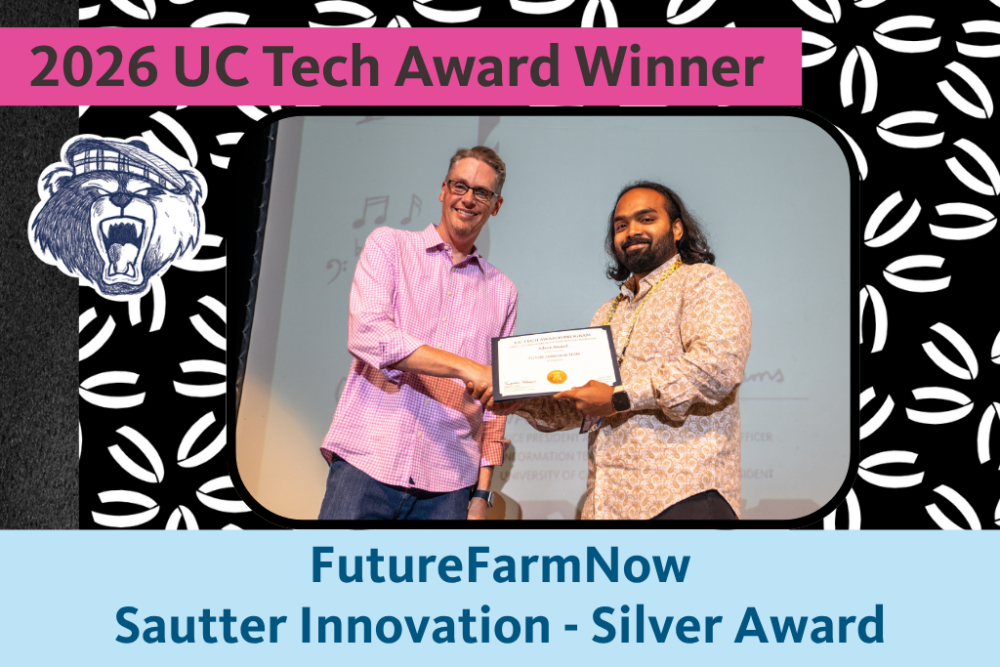
The FutureFarmNow team won the Silver Larry L. Sautter for Innovation in IT Award at the 2026 UC Tech Awards for creating FutureFarmNow: a free, bilingual web and phone platform that turns satellite-based data into practical field decisions for California farmers and researchers.
Project Summary
California agriculture relies on farmers – many of whom operate small and mid-sized, family-owned farms – to make daily decisions about irrigation, soil health, pest management, and crop timing. Yet the data tools needed to support these decisions are often expensive, fragmented, and technically complex to use without specialized training.
The FutureFarmNow team addressed this challenge by collaborating with agricultural scientists, UC ANR advisors, and geospatial systems researchers to transform complex satellite, soil, weather, and field-boundary data into a real-time, map-based platform that nontechnical users can access for free from the web or phone. The platform, called FutureFarmNow, brings 13 datasets and tools, and seven core workflows together in one place.
The team also developed FarmBot: a bilingual English- and Spanish-language AI assistant that helps users understand and act on field data. Using live domain tools and public data sources, it gives context-specific responses based on current field conditions.
FutureFarmNow serves all California farmers, providing equitable access to the same data tools available for large commercial operations. The project also transformed UC research and innovation into a practical, reusable, statewide service that helps farmers make more informed agricultural decisions.
Suryaa Charan Shivakumar, the team representative, shared some of his thoughts on the project and its impact in the Q&A below.
How did collaboration across teams or campuses shape the project?
FutureFarmNow was shaped by collaboration across teams, departments, and campuses. The project is part of a U.S. Department of Agriculture National Institute of Food and Agriculture (USDA NIFA)-funded initiative led by Dr. Elia Scudiero in UCR’s Department of Environmental Sciences, with collaborators from UCR Computer Science, partner universities, and research centers.
Dr. Scudiero created the FutureFarmNow Work Package to translate research into a web and mobile application for farmers and the broader community. Zhuocheng Shang transformed the prototype developed by Dr. Scudiero and Dr. Anderson into a scalable algorithm serving all of California. Suryaa Charan built the front-end app and added user-friendly features, including the AI assistant.
What did winning this UC Tech Award mean to your team personally or professionally?
Winning the UC Tech Award validated a choice we made early: build for farmers and researchers first, and let engineering follow. The recognition showed that UC values technology for technical sophistication, but also for bringing people together and creating meaningful work for the community.
Our team is small, and much of the work is plumbing: workflows that recover from partial failure, observability that shows what is running, and a frontend that respects how researchers work. Recognition matters because this work is invisible.
Personally, it confirmed that engineering close to users, being honest about tradeoffs, and showing patience with unglamorous details is worth pursuing long-term.
How has this project shaped your perspective personally or professionally? What’s something you’re proud of?
This project changed how we think about applied AI. We used to see AI as the headline feature. Now we see it as one layer in a system that also needs reliable workflows, observability, governance, and a clear operator experience.
What we are proud of is the core: solid workflows, well-integrated data sources, and a big-data interpretation layer that makes complex agricultural data accessible to the community. The AI layer sits on top of that tooling to ease access for farmers and researchers. The core itself is multiple departments researching domain-level solutions and integrating them.
What’s next for this project?
First, we are extending the assistant from answering questions to executing multi-step decisions, using the same guardrails and observability built into the platform. Second, we will work closely with UC Agriculture and Natural Resources (UC ANR) to bring the platform to Western US farmers through outreach programs, gather field feedback, and feed that signal back into the model and core.
In parallel, we’ll continue integrating new data pipelines and collaborating with agricultural scientists at UCR and the USDA Salinity Lab. The thesis stays the same: AI is only useful in agriculture if farmers can trust what it does next.
Contact
Suryaa Charan Shivakumar, Senior Applications Programmer, Computer Science Department, UCR