UC Tech News is excited to launch the UC Tech Leaders Q&A Series in 2026—a series designed to spotlight the voices shaping technology across UC.
What is Your Name?
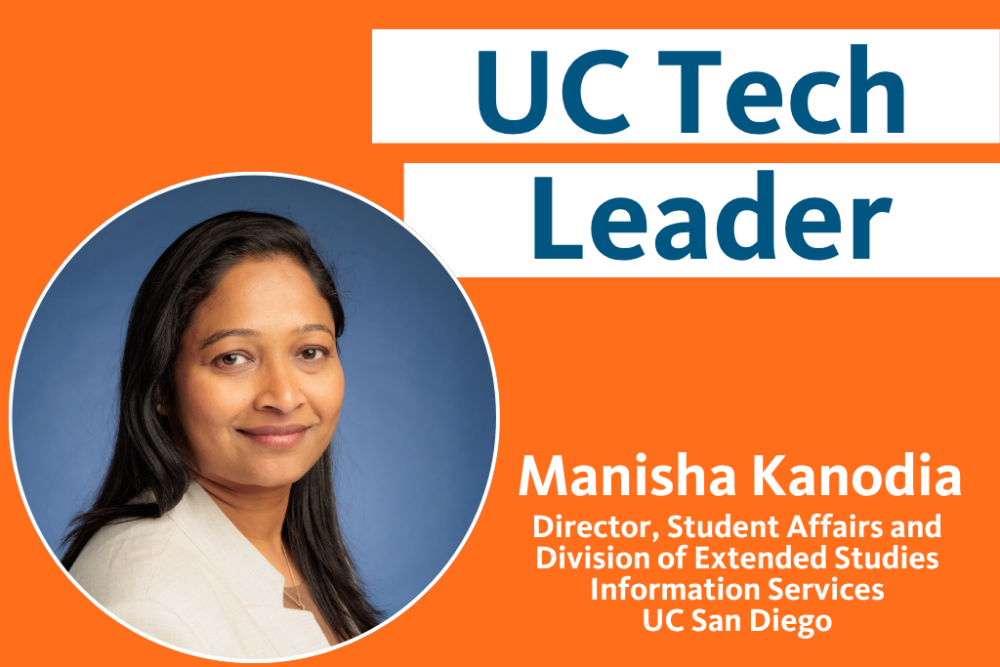
Manisha Kanodia
What is Your Title? UC Location?
Director, Student Affairs and Division of Extended Studies Information Services at UC San Diego
What are Your Top IT/Security Priorities in 2026?
My top IT and security priorities in 2026 are centered on streamlining data integrations and strengthening secure collaboration across systems and teams. As organizations continue to adopt multiple platforms and cloud-based solutions, seamless and secure data flow becomes critical to operational efficiency and informed decision-making.
I plan to focus on modernizing integration frameworks, reducing system redundancies, and implementing standardized data governance practices. Equally important is ensuring that integrations are built with security by design, embedding strong access controls, encryption standards, and continuous monitoring into every layer of the data ecosystem. By aligning integration strategy with cybersecurity best practices, we can enable innovation and cross-functional collaboration while safeguarding institutional data and maintaining compliance.
What Emerging Tech Excites You for Higher Ed?
The emerging technology that excites me most in higher education is AI’s ability to transform both operations and the student experience. Higher education institutions often rely on complex, resource-intensive workflows that require significant manual effort. When implemented thoughtfully, AI can automate routine administrative tasks, improve data accuracy, and free faculty and staff to focus on higher-value, student-centered work. I’m particularly excited about AI agents that can support personalized tutoring, academic planning, advising, onboarding, and administrative services.
These intelligent assistants have the potential to enhance learning, increase engagement, and provide timely, personalized support throughout the student journey. Beyond automation, the greatest opportunity lies in combining AI with process redesign. Rather than simply digitizing existing workflows, AI enables institutions to rethink processes end-to-end and eliminate redundancies, accelerating service delivery, and improving both the student and employee experience. With strong governance, security, and ethical safeguards, AI can become a powerful catalyst for innovation, operational excellence, and institutional agility in higher education.
What Emerging Tech Worries You?
While AI is incredibly promising, it is also the emerging technology that concerns me the most. My primary concern centers on data security and privacy. As AI systems increasingly rely on large volumes of institutional and personal data, the risk of misuse, unintended exposure, or insufficient governance becomes more significant, especially in higher education environments that manage sensitive student and research data.
Additionally, I’m concerned about the gap between the rapid advancement of AI technologies and the pace at which higher education curricula are evolving. There is a growing need to equip students, faculty, and staff with not just technical skills, but also a strong foundation in ethical AI use, data stewardship, and responsible innovation. Without this, we risk scaling AI adoption without the necessary expertise and guardrails. Addressing these challenges will require a dual focus: strengthening data governance and security frameworks, while also investing in education and training to ensure AI is implemented thoughtfully, ethically, and at scale.
How Do You Balance Innovation with Security?
Security is fundamental to sustainable innovation. Innovation initiatives cannot succeed long term without a strong security framework embedded from the outset. Achieving the right balance between innovation and security requires ensuring that new technologies and solutions do not introduce operational risks or compromise privacy and data protection.
I believe in engaging security teams early in the innovation process and partnering closely with them to follow established security guidelines and principles. At the same time, innovation often presents opportunities to evolve and strengthen those frameworks to support emerging technologies and new ways of delivering value. By integrating security into the design and implementation process, organizations can foster innovation while maintaining secure and reliable operations that enhance the customer experience.
What Principles/Values Shape Your Leadership?
A mentor once wrote the following about me in a reference they were providing – “The true mark of a leader is being able to build relational capital with others so that they will follow you not because of your organizational position but because they believe in where you can take them!” This compliment for me has been a guiding principle as I continue my leadership journey – To Lead is to LEARN, EXPERIMENT, ADAPT and DISCOVER
What Books are You Currently Reading?
Never Eat Alone – Keith Ferrazzi
What’s Your Favorite Thing to Do Outside of Work?
Experimenting with new recipes.
Thank you for the conversation, Manisha!

Manisha Kanodia
Director, Student Affairs and Division of Extended Studies
Information Services
UC San Diego
Tech Leader Spotlights
UC Tech News is excited to launch the UC Tech Leaders Q&A Series in 2026—designed to spotlight the voices shaping technology across UC. The UC tech community values hearing directly from its leaders, and this series aims to be both inspiring and informative.
Are you a tech leader at UC? We’d love to hear from you! To participate, please complete the short Q&A form and please include a photo.