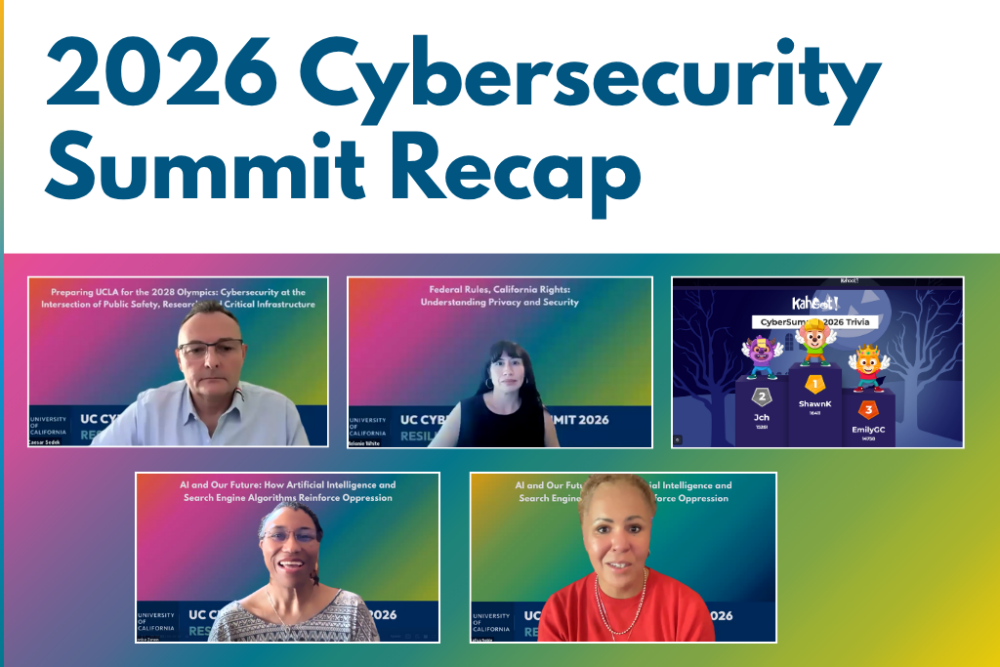
The 2026 Cybersecurity Summit was held virtually on October 6-7, 2026. More than 780 attendees from the University of California, California State University, and California Community Colleges came together under this year’s theme, Resilient Together, to learn, connect, and strengthen our collective approach to cybersecurity. Over two half-days, participants explored timely topics including artificial intelligence, privacy and security regulations, deepfake scams, fraud prevention, critical infrastructure protection, and online safety.
To learn more about the event, view the event Program Book, which includes the agenda, speaker bios, and session descriptions.
Read on for key takeaways and highlights from each session!
Day One Highlights
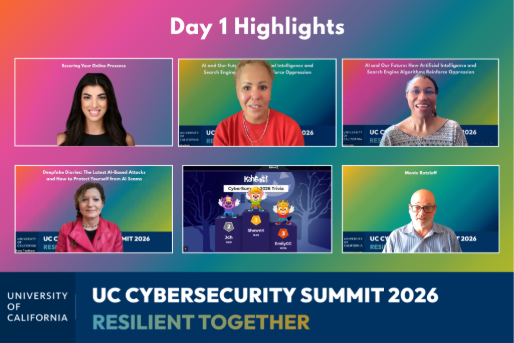
Securing Your Online Presence
Day 1 kicked off with an engaging keynote from Caitlin Sarian (@CybersecurityGirl), the world’s largest cybersecurity educator and influencer with 3.1 million followers across platforms, who shared how common scams work and why anyone can be vulnerable.
Through examples, she unpacked the psychological tactics scammers use to manipulate emotions and explained how they leverage information from your digital footprint – the trail of information you leave when you use the internet – to tailor stories that feel relevant and believable. Something as simple as a birthday post, job announcement, or upcoming travel plans comment can provide the details needed to build a convincing scam long enough to get you to do what a scammer asks.
Sarian encouraged attendees to be more intentional about what they share and to adopt one simple habit when faced with suspicious requests: Stop. Verify. Act.
“You don’t need to disappear from the internet. But we can be more deliberate about which parts of our lives are available and with whom,” she said.
AI and Our Future: How Artificial Intelligence and Search Engine Algorithms Reinforce Oppression
In a thought-provoking conversation on AI, search engines, and social justice, Dr. Safiya Noble, David O. Sears Presidential Endowed Chair at UCLA, and moderator Ronise Zenon, Information Systems Analyst at UC San Diego, explored how artificial intelligence and search technologies can reinforce existing inequities rather than operate as neutral systems.
Drawing on years of research, Noble challenged attendees to question the assumption that algorithms are objective and encouraged them to scrutinize technology before adopting it. One of her key takeaways was that AI systems are trained on data that reflects society’s historical biases, meaning discriminatory patterns can be embedded into future decision-making if left unchecked.
As Noble explained, “The discrimination has been turned into data, and it is used to train models,” an eye-opening reminder that technology often mirrors the values and inequities found in the information it consumes. Her session underscored the importance of critical evaluation, accountability, and human expertise in building a more equitable digital future.
Deepfake Diaries: The Latest AI-Based Attacks and How to Protect Yourself from AI Scams
Kerry Tomlinson, Cyber News Reporter at Ampyx News, discussed how deepfakes and AI-generated scams are evolving and what individuals can do to protect themselves.
Using examples gathered during her undercover investigations, Tomlinson demonstrated that the biggest danger is often not the quality of the deepfake itself, but the psychology they use along with it. From fake celebrity endorsements and investment schemes to AI-generated fraud and misinformation, she emphasized that scammers exploit emotions such as hope, fear, urgency, and curiosity to bypass critical thinking.
“If they can flip that switch in us… our brains will do the work for them,” Tomlinson said. She encouraged attendees to pause and evaluate intent, consider the consequences, and verify information whenever possible.
Cybersecurity Trivia
Day 1 concluded with a spirited cybersecurity trivia activity led by Adrian Mohuczy-Dominiak, Systemwide Cybersecurity Threat and Risk Manager at UC Office of the President. Participants competed for Amazon gift cards while testing their knowledge across a wide range of topics related to cybersecurity, from famous movie and television quotes to historic milestones and terminology. The lively competition brought attendees together for an entertaining finish to the day.
Day Two Highlights
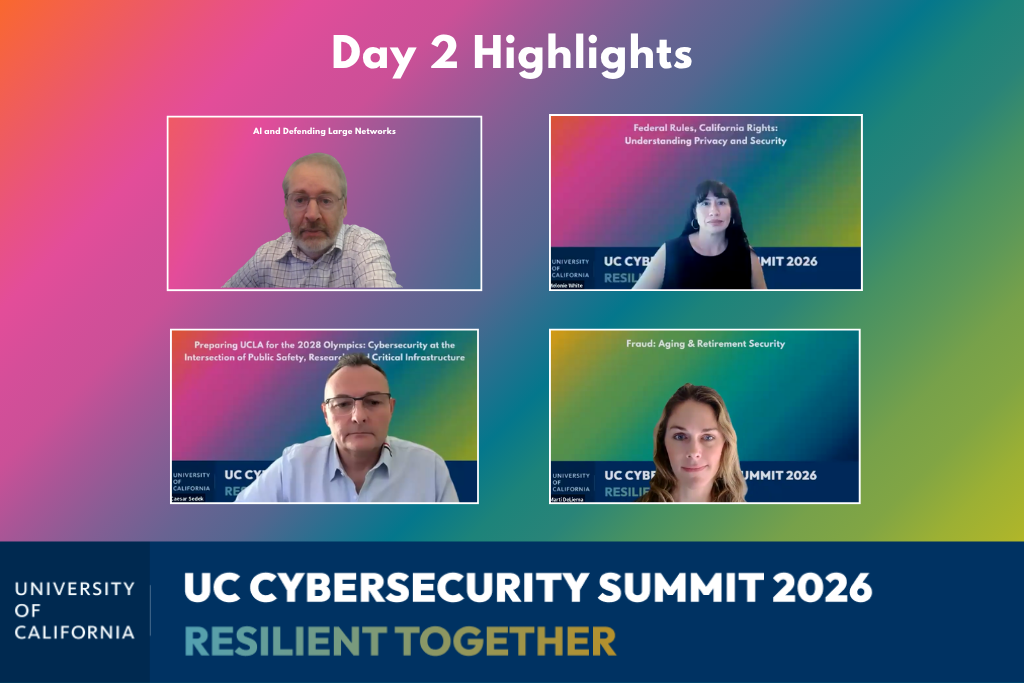
AI and Defending Large Networks
On Day 2, Bradley Bowness, Executive Counselor at Info-Tech Research Group, opened with a timely session on how organizations can prepare for and defend against an increasingly AI-driven cyber threat landscape. Bowness stepped in for Alex Stamos, who unfortunately was unable to join the event.
Drawing on recent examples of AI-assisted attacks that moved from vulnerability discovery to widespread compromise in a matter of hours, Bowness emphasized that security teams must be prepared to act at machine speed. One of his key recommendations was to establish pre-authorized containment actions, clear decision-making authority, and AI-assisted detection processes before an incident occurs, rather than relying on traditional response timelines.
While AI can help organizations detect and respond to threats faster, Bowness reminded attendees that technology alone is not enough. “You can buy speed, you can’t buy accountability,” he said. It is important to pair AI-enabled defenses with strong governance, preparation, and recovery planning.
Federal Rules, California Rights: Understanding Privacy and Security
Melonie White, Digital Risk Governance, Analytics, and Advisory Services Manager at UC Office of the President, explored how federal and California privacy and security laws govern the collection, use, and protection of personal information, from healthcare and education records to online purchases and location data.
White began by explaining that privacy and security are closely connected but serve different purposes. Privacy asks whether information should be collected, used, or shared in a particular way, while security focuses on how to protect that information from unauthorized access or misuse.
Building on that foundation, she illustrated how people can encounter several privacy and security frameworks in a single day: a medical appointment, university login, credit check, or online purchase may each involve different laws and requirements. To understand what protections may apply, White encouraged attendees to ask: What information is involved, who is the organization that has it, and what activity is being done with it?
As she noted, “Good cybersecurity doesn’t automatically make every use of information appropriate,” reminding attendees that protecting yourself requires understanding not only how data is secured, but also how it is used.
Preparing UCLA for the 2028 Olympics: Cybersecurity at the Intersection of Public Safety, Research, and Critical Infrastructure
With the 2028 Olympic Games coming up, Caesar Sedek, Assistant Chief Information Security Officer at UCLA, shared how the university is preparing for the cybersecurity challenges of such a high-profile event while continuing to support critical services across research, healthcare, public safety, and campus operations.
One of his most practical messages was that cybersecurity readiness starts with understanding what assets exist, who owns them, and whether those owners have the authority to act when issues arise. Sedek emphasized that many security problems are ultimately ownership and governance challenges rather than purely technical ones.
“Vulnerability management starts way before the patch. It’s with knowing whose job it is to get the service safely to a better place,” he said. His session highlighted the importance of clear accountability, trusted communication channels, and coordinated response plans that remain effective long after a major event concludes.
Fraud: Aging and Retirement Security
The last session of the Summit by Marti DeLiema, Associate Professor at the University of Minnesota, brought a researcher’s perspective on the factors that can make older adults more vulnerable to financial fraud.
DeLiema highlighted how conditions often associated with later life, including loneliness and social isolation, major life milestones, and cognitive decline, as well as risky routine activities (like entering lotteries or not hanging up on telemarketers) and overconfidence with a lack of actual financial literacy, can increase susceptibility.
When asked by attendees how to approach aging loved ones about this topic, she encouraged starting the conversation from a place of openness and planning rather than fear.
“Having a conversation about financial decisions and cognitive decline can be really triggering for older adults. What we found in our kind of market research, through focus groups with older adults, is that they preferred talking about money and coming up with a financial contingency plan as something that you want to have for ‘peace of mind.”’
DeLiema also reminded attendees that these discussions are rarely a one-time event, but instead “happen over months,” giving families time to build trust and develop a plan together. She referred to the free Thinking Ahead Roadmap resource that she and organizations helped create as a resource for conversations.
By the Numbers
Post-event survey feedback from 80 respondents indicated a positive experience across all major event measures. Attendees rated the virtual experience highly, with 88% reporting they were satisfied or very satisfied, while 86% were satisfied or very satisfied with the quality of speakers. The Summit’s content also resonated with participants, with 82% reporting satisfaction with the relevance of session topics.
These results reflect the Summit’s continued success in bringing together our cybersecurity community for timely conversations on cybersecurity, privacy, emerging technologies, and digital resilience.
“The topic were insightful to help keep our minds open to different possibilities of how AI can affect our business infrastructure security and in our personal life.”
“Thought-provoking, informative, and timely.”
“Informational even for someone who is already somewhat aware of risks in the digital age.”
Thank You, Sponsors
Looking Ahead: 2027 UC Cybersecurity Summit
With the success of 2026 behind us, planning for the 2027 Summit is already underway! Stay tuned to the Cybersecurity Summit webpage or join the Summit mailing list with your UC email address to get the latest event news. We look forward to seeing you next year!
Know of a great speaker, topic, or idea we should feature? We’d love to hear from you! Please email us at uccybersummit@ucop.edu to share your suggestions.
Contact
UC Cybersecurity Summit Planning Team
uccybersummit@ucop.edu