UC Tech News is excited to share the stories of the people and projects behind the winners of the 2026 UC Tech Awards.
Team Name: UCSD Health Enterprise Automation Team
Award Category: Mojgan A. Amini Operational Excellence
Location: UC San Diego Health
Team Members:
- Jessica Alicdan
- Erik Taylor
- Karri Benjamin
- Lizzy Case
- Zammy Wang
- Allen R. Tran
- Calvin Fong
- Frank Edward Myers III
- Francesca J. Torriani
- Priscilla Cardenas
- Chris Granda
- Victoria Gulotta
- Haidee V. Perez-Gutierrez
- Jenna McClanahan
- Anna Navasartyan
- Dante Segundo
- Tiara Johnson
- Tran Chau
- Cynthia Dullano
- Wilmar Flores
- Dean Pham
- Jill Martin
- Brian Clay
- Marcia Isakari
- Brittney Daniels
- Laura Kimmich
- Dora Duran
- Divya Gupta
- Mitchel Jones
- Chad Vandenberg
- Gerard W. Phillips
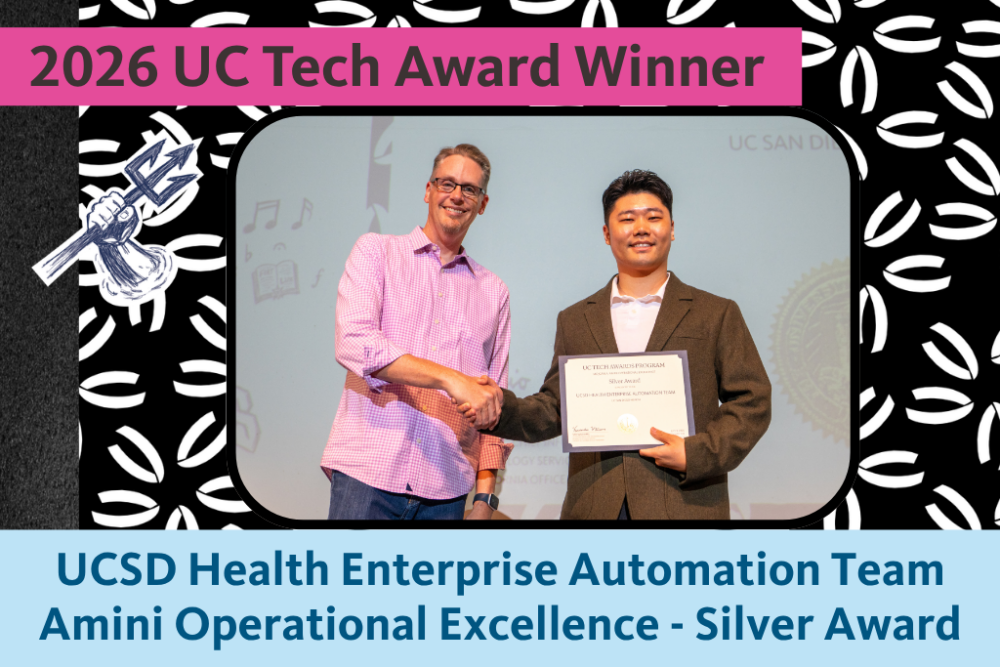
The UCSD Health Enterprise Automation Team won the Silver Mojgan A. Amini Operational Excellence Award at the 2026 UC Tech Awards for building two fully automated workforce safety systems that enabled round-the-clock infectious disease exposure notification and compliance tracking.
Project Summary
As UC San Diego Health expanded to more than 18,000 staff across inpatient, ambulatory, and academic care settings, two critical workforce safety systems became increasingly difficult to manage consistently through manual methods.
The first system, infectious disease exposure notifications, required staff from Interprofessional Continuing Education (IPCE) to manually contact every potentially exposed employee – a process limited by business hours and staff availability. The second system, Flu and FIT compliance, relied on staff from the Center for Occupational and Environmental Medicine (COEM) to manually track and notify non-compliant employees.
The organization needed a more reliable, scalable solution that could operate round-the-clock, support multiple systems and departments, maintain detailed audit records, and meet the strict security and regulatory requirements expected in a healthcare environment.
Action
To address these needs, the UCSD Health Enterprise Automation Team partnered with the IPCE and COEM departments to design two automated workforce safety systems powered by Epic integrations and Microsoft technologies.
For exposure notification, the team implemented a dual-flow Power Automate architecture that enables immediate, 24/7 responses to the IPCE’s submissions. Flow 1 reads the Bugsy submission, matches the affected staff against employee records in Epic, and makes a timestamped notification record in SharePoint. Flow 2 distributes a survey (Exposed / Not Exposed / Unsure) to the exposed employee, automatically escalates to the IPCE if employee data is missing, and maintains a complete audit trail.
For Flu and FIT compliance, the team built a two-track pipeline. The “direct outreach” track runs a Power Automate flow to send weekly notifications to the non-compliant staff and provider. The “supervisor notification” track uses a custom Python application to generate a supervisor-grouped compliance report. Then a COEM clinician reviews and releases the report via a Teams channel, which triggers a Power Automate flow to send alerts to managers across the health system. This human-in-the-loop design allows the COEM to choose when and whether supervisor outreach is appropriate.
Results and Impact
The solution has significantly improved the speed, consistency, and scale of workforce safety operations across UC San Diego Health. Every identified exposure event now triggers employee outreach regardless of the time of day. Compliance workflows can process more than 18,000 employee records each week without manual intervention.
These efficiencies have translated into measurable results:
- FIT (N95 fit testing) compliance increased from 60 percent to 91 percent, a 31-point gain.
- Flu vaccination non-compliance decreased from ~2,000 employees taking no action to 600, a 70 percent reduction.
- In November 2024, a single automated run distributed more than 900 supervisor notifications covering over 5,000 non-compliant employees.
The solution has also delivered benefits beyond workflow efficiency. With a complete audit trail from exposure notification through response, UC San Diego Health now has the regulatory documentation capability that occupational health accreditation standards require. By taking over notification and tracking tasks, automation has freed clinical staff and unit managers to focus their expertise on patient care.
The UCSD Health Enterprise Automation Team delivered more than an operational improvement. They created a scalable, sustainable workforce safety solution that extends organizational capacity, strengthens employee protection, reduces administrative burden, and provides a framework that can be replicated across other UC Health campuses with minimal adaptation.