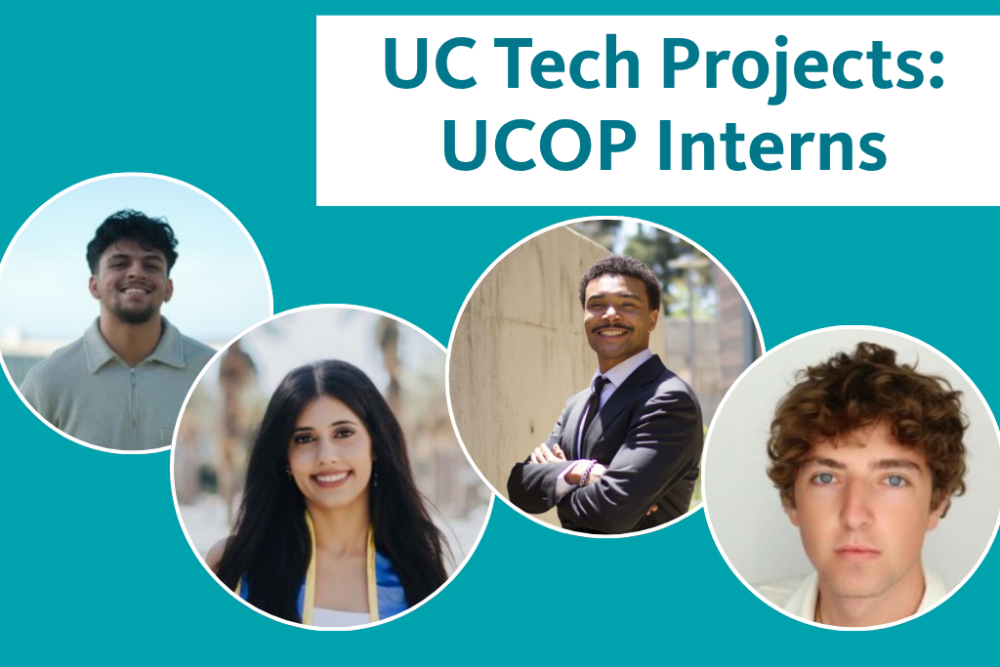
This summer, UC Investments and the UCOP Digital Innovation and Technology (DigIT) team welcomed a standout class of interns who worked across teams, building tools designed to last long after the summer ends. Private equity dashboards, AI-powered HR assistants, custom investment tracking tools — these are practical, real-world solutions built with intention.
One common thread: AI. Nearly every intern leveraged tools like Codex, ChatGPT, and Microsoft Power Automate to bring their ideas to life — and came away with a deeper appreciation for both the power and the limits of AI in professional settings. We asked a few of the interns to share their experiences.
Meet the 2026 interns:
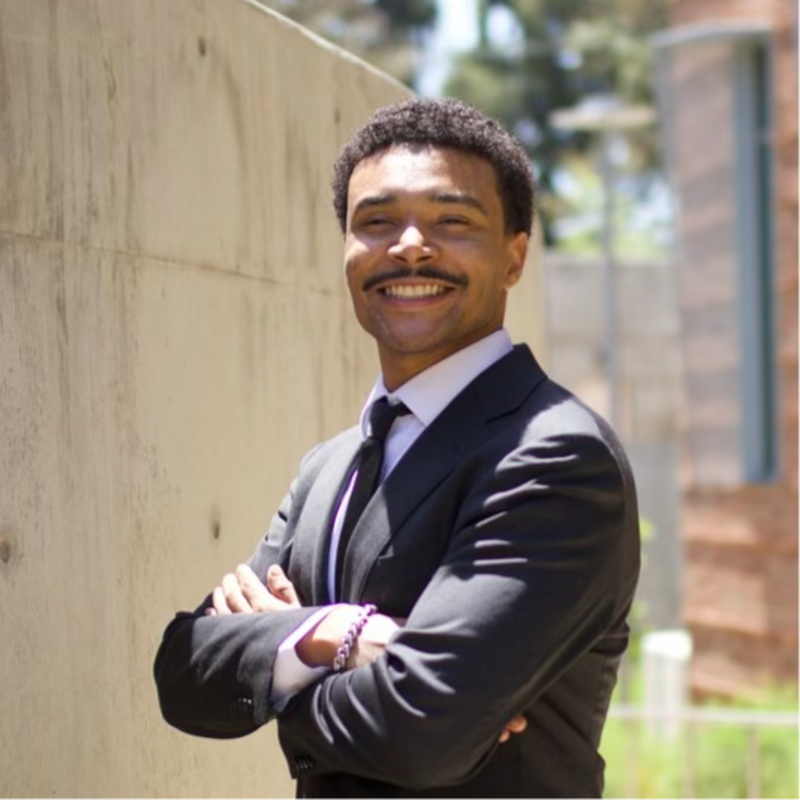
Christian Castillo
UCOP team you worked with: UC Investments—Private Equity team, working with Jeffrey Youngman and Lucy Chang.
What was your favorite project you worked on?
My favorite project was building a Private Equity Performance Dashboard using Codex and AI-assisted development.
Description of the project:
I developed an interactive dashboard designed to help the Private Equity team better understand what is driving performance across the portfolio. Rather than only showing the overall return, the dashboard drills down into key drivers of value creation, including revenue growth, EBITDA growth, and multiple expansion. It also compares the Private Equity portfolio against the Russell 3000 benchmark. I wanted to build something that the team could use for a very long time, not just a static Excel file that the team would look at once. I learned just how much AI can help with coding now and made something that will last for the team.
What was the goal of the project?
The goal was to give the team a more efficient way to understand why the portfolio is performing the way it is, not simply what the return is. By comparing the underlying growth and valuation drivers of the Private Equity portfolio with the public-market benchmark, the dashboard provides another perspective for evaluating private equity performance.
What was the outcome?
The outcome was a working dashboard that can be updated each quarter with new data. It allows the team to see revenue growth, EBITDA growth, and multiple expansion for the private equity portfolio alongside the Russell 3000 benchmark, creating a tool that will last even once I am gone, and update itself every quarter showing the performance analysis.
What did you learn?
This project taught me a lot about both Private Equity and AI. On the Investment side, I learned that understanding performance goes much deeper than looking at a headline return. I learned how investors can break down value creation to understand whether performance is being driven by growth in the underlying businesses, improvements in profitability, or changes in valuation multiples. I also learned how institutional investors think about benchmarking and performance attribution and how LP (limited partner) perspective differs from the GP (general partner) perspective.
On the AI side, I learned how to use Codex to turn an idea into a working product. I became much better at communicating what I wanted the AI to build, troubleshooting problems, validating outputs, and making sure the AI has guardrails so it doesn’t do whatever it wants. One of my biggest takeaways was that AI can make development and research much faster, but human judgment is still extremely important, ESPECIALLY when working with investment data.
What’s Next? What are your career aspirations?
This experience strengthened my interest in portfolio management, investment research, and the intersection of investing and technology. Going forward, I want to continue developing my understanding of how institutional investors and asset managers allocate capital across public and private markets, and how tools like AI can improve research and portfolio management. My goal is to continue building my technical and investment skill set while gaining experience in portfolio management, asset allocation, manager research, or investment consulting. This summer at UC Investments helped me realize that I really enjoy looking at investments from a broader portfolio perspective rather than focusing only on individual companies.
LinkedIn: Christian Castillo | LinkedIn

Shivam Sharma
UCOP team you worked with: Digital Innovation & Technology (DigIT).
What was your favorite project you worked on?
Developing an AI-powered UCPath Workforce Administration (WFA) Assistant.
Description of the project:
I designed and built a conversational AI assistant in collaboration with another intern, Ulices Ramirez, that helps new employees and HR professionals navigate UCPath Workforce Administration processes. The assistant uses ChatGPT, Tableau, and Power Automate to answer questions, guide users through workflows, generate emails, and connect with internal resources.
What was the goal of the project?
The goal was to simplify onboarding and day-to-day HR support by providing an intuitive AI assistant that reduces time spent searching documentation and improves access to information.
What was the outcome?
The project resulted in a working prototype that demonstrates how generative AI can streamline HR workflows, improve the employee experience, and serve as a foundation for future AI-enabled business processes across the University of California.
What did you learn?
I learned how to bridge business needs with AI technology by working closely with stakeholders, designing user-focused solutions, and integrating multiple Microsoft AI and automation tools into a practical workflow.
What’s next? What are your career aspirations?
I hope to pursue a career in AI strategy, product management, or technology consulting, where I can continue building solutions that connect business challenges with emerging AI technologies and create meaningful impact.
LinkedIn: Shivam Sharma | LinkedIn

Harkirit Dhillon
UCOP team you worked with: UC Investments Artificial Intelligence.
What was your favorite project you worked on?
AI-Powered Outlook.
Description of the project:
Developed a supervised AI agent that reviews Outlook emails, filters less relevant messages, and organizes information into a clear, interactive table for easier follow-up.
What was the goal of the project?
The goal was to make email triage more efficient by helping users quickly identify important messages, priorities, and follow-up items while keeping the user in control.
What was the outcome?
The supervised agent streamlined email review by surfacing relevant messages, organizing key information, linking users back to the original Outlook email, and supporting follow-up actions such as calendar invitations.
What did you learn?
I learned how to design AI workflows around real business processes, work within connector and data-access limitations, test supervised agents, and balance automation with human oversight.
What’s next? What are your career aspirations?
I plan to continue building experience at the intersection of business, technology, and artificial intelligence. My long-term goal is to work on AI-driven strategy and transformation initiatives that improve how organizations operate and make decisions.
LinkedIn: Harkirit Dhillon – University of California Office of the President | LinkedIn

Victor Silverman
UCOP team you worked with: UC Investments, Real Estate.
What was your favorite project you worked on?
Developing a customized relationship management and investment deal-tracking dashboard.
Description of the project:
I designed and built a local dashboard that combines relationship management with direct investment and co-investment tracking. The tool connects people, firms, meetings, investment opportunities, portfolios, and diligence activity in one interface, while using Excel as a portable underlying data source.
What was the goal of the project?
The goal was to create a more intuitive and customizable way to organize investment relationships and deal activity. Rather than adapting investment workflows to a traditional CRM, the dashboard was designed around the specific needs of an institutional investment team.
What was the outcome?
The project resulted in a working prototype that demonstrates how a tailored internal tool can make relationship intelligence, investment opportunities, and diligence workflows easier to navigate while maintaining a flexible and portable data structure.
What did you learn?
I learned how to translate investment-team needs into a practical technology solution, think more systematically about relationship and deal data, and use AI-assisted development tools to build and iterate on a functional application.
What’s next? What are your career aspirations?
I hope to pursue a full-time career in institutional investment management and asset management.
LinkedIn: Victor Silverman | LinkedIn
Thank you to the UCOP interns who shared their favorite projects, learnings, and career aspirations with us! We appreciate all of your hard work during your time at UCOP and wish you the best in your next steps!