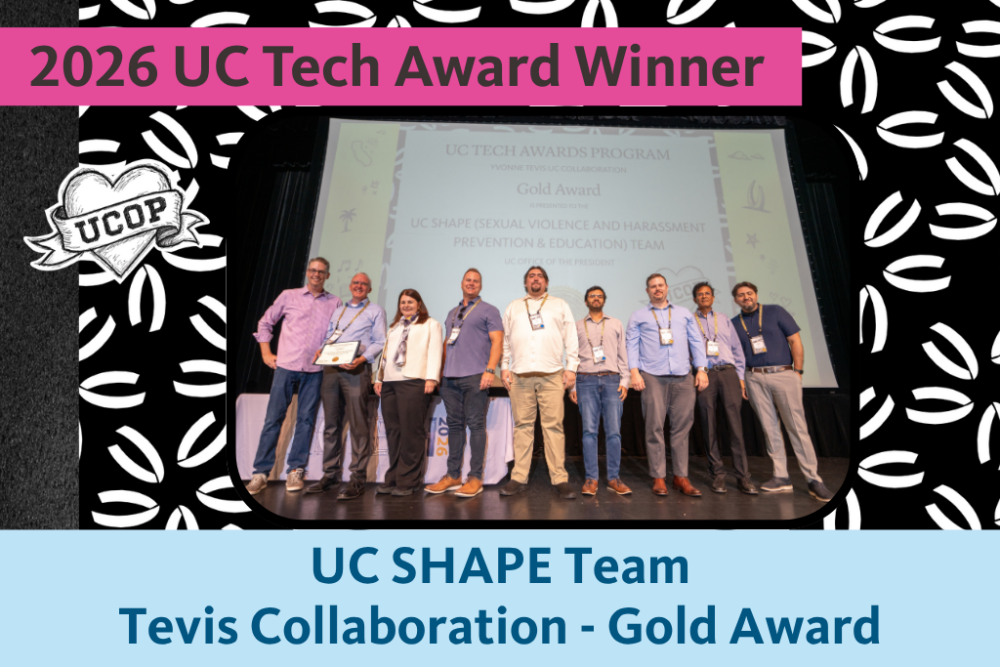
UC Tech News is excited to share the stories of the people and projects behind the winners of the 2026 UC Tech Awards.
Team Name: UC SHAPE (Sexual Violence and Harassment Prevention & Education) Team
Award Category: Yvonne Tevis UC Collaboration
Location: UCOP
Team Members:
- Carson Sprott – Principal Investigator, Systemwide Office of Civil Rights (SOCR), UC Office of the President (UCOP)
- Isabel Alvarado – Systemwide Title IX Deputy Director, SOCR, UCOP
- Nicoli Richardson – Systemwide Title IX Director, SOCR, UCOP
- Shohreh Bozorgmehri – Interim Chief of Staff to the UCOP ClO, UCOP Digital Innovation & Technology (DIT), UCOP
- Timothy Hanson – Senior Information Security Manager, DIT, UCOP
- Eric Goodman – Security Architect, DIT, UCOP
- Fernando Corral – Manager of Learning Technologies, UC Online, UCOP
- Todd Van Zandt – Director of Academic Technology, UC Online, UCOP
- Sri Tummala – Associate Director of Technology Development, UC Online, UCOP
- Anton Karpenko – Systems Administrator, UC Online, UCOP
- Venkata Vajrala – Applications Programmer, UC Online, UCOP
- Adam Flanders – Technical Project Manager, UC Online, UCOP
- Priya Mishra – Applications Programmer, UC Online, UCOP
In partnership with campus Title IX officers, LMS administrators, and student information system technical teams across all UC campuses.
The UC SHAPE (Sexual Violence and Harassment Prevention & Education) Team won the Gold Yvonne Tevis UC Collaboration Award at the 2026 UC Tech Awards for delivering secure, systemwide compliance training to over 300,000 UC students annually through a unified, UC-owned platform that improves access, efficiency, and data security.
Project Summary
UC needed a more sustainable way to deliver mandatory Title IX and anti-discrimination training to more than 300,000 students annually. As training requirements expanded and reliance on a third-party vendor created operational, accessibility, data governance, and support challenges, the existing model became increasingly difficult to maintain. Addressing the issue required a systemwide effort to create a secure, scalable solution that could improve the student experience, strengthen oversight, and reduce administrative burden across all UC campuses.
UC Online partnered with the Systemwide Office of Civil Rights, UCOP Information Technology Services, and campus stakeholders to develop SHAPE, a centrally hosted, UC-managed compliance training platform. By integrating directly with campus learning management systems, providing flexible administrative tools and automation options, and prioritizing security and data governance, SHAPE delivers a seamless training experience while giving campuses greater visibility, control, and efficiency.
Since launching in June 2025, SHAPE has transformed compliance training delivery across the UC system, supporting more than 300,000 students through a fully integrated and accessible platform. The solution has streamlined administrative processes, improved reporting and compliance tracking, reduced reliance on manual workflows, and strengthened institutional control over sensitive data. Beyond its immediate benefits, SHAPE provides a scalable model for future systemwide technology services that balance centralized infrastructure with campus flexibility.
Todd Van Zandt, the team representative, shared some of his thoughts on the project and its impact in the Q&A below.
How did collaboration across teams or campuses shape the project?
SHAPE succeeded because it was truly a systemwide collaboration. UC Online partnered closely with the Systemwide Office of Civil Rights, UCOP Information Technology Services, and campus Title IX offices, LMS administrators, registrars, and technical teams. Every campus brought unique business processes and technical environments, so listening, adapting, and building trust were just as important as writing code. Rather than imposing a one-size-fits-all solution, we designed a shared platform with flexible implementation options. That collaborative approach created a solution that campuses could confidently adopt.
Was there any user feedback that stood out and led to a meaningful change in your project?
One of the most valuable pieces of feedback came from campus compliance officers and technical teams, who emphasized that campuses had different levels of technical maturity. Some wanted fully automated integrations, while others needed simple manual tools. That feedback led us to design SHAPE with both a secure web portal and API-based services. By supporting multiple implementation paths, we reduced barriers to adoption and ensured every campus could participate immediately while still providing a roadmap toward automation.
What did winning this UC Tech Award mean to your team personally or professionally?
This award recognizes much more than a successful technology project; it celebrates the relationships and partnerships that made it possible. We spent two years working alongside colleagues at UCOP and every campus to solve a complex systemwide challenge. Receiving the UC Tech Award validates that collaboration, shared purpose, and persistence can produce meaningful outcomes for the University. Professionally, it’s rewarding to see the work recognized, but even more meaningful is knowing we’ve built a service that benefits the UC students and campuses.
How has this project shaped your perspective personally or professionally? What’s something you’re proud of?
This project reinforced that successful technology initiatives begin with planning and listening. The most important work wasn’t developing software; it was understanding campus needs, building consensus, and designing solutions that respected local autonomy while supporting systemwide goals. We’re especially proud that SHAPE demonstrates how UC can leverage shared expertise to solve complex challenges together. The technology is important, but the trust we built among campuses and UCOP partners is what made the project successful.
What did you learn from this experience that you can share with other UC teams?
Start with partnership. Bringing stakeholders together early, being transparent about challenges, and designing with flexibility in mind made all the difference. We also learned that successful shared services don’t require every campus to work the same way; they require a common platform that accommodates different operational needs. Investing time in governance, communication, and functional user engagement was key.
What’s next for this project?
SHAPE was designed as a foundation, not a finish line. Our next priorities include expanding automation, enhancing compliance reporting and analytics, and continuing to simplify administrative workflows for campuses. We’re also exploring opportunities to extend the platform to support additional UC-managed compliance training programs beyond Title IX. The collaborative framework established through SHAPE provides a model for delivering future systemwide services that are secure, scalable, and responsive to campus needs.
Contact
Todd Van Zandt, Director of Academic Technology, UC Online, UCOP
Todd.VanZandt@ucop.edu