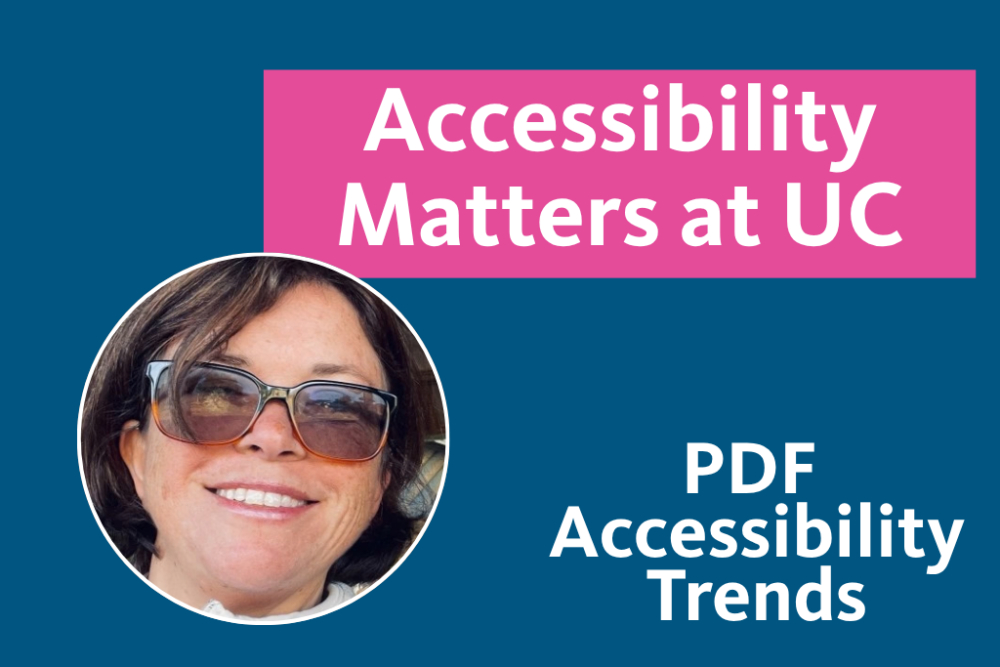
By Jamie Herrera, Accessibility Program Manager
Across higher education, PDF accessibility has moved from a niche compliance concern to a campus-wide priority. In the University of California system, remediation remains a significant challenge as campuses work to meet accessibility requirements and improve digital equity. New technologies and more intentional processesi offer ways to create accessible documents more sustainably.
AI-assisted remediation is one of the most discussed developments in 2026. A growing number of AI-assisted accessibility platforms,ii including Adobe Acrobat’s Make Accessible guided action, Adobe APIs and recent PDF Accessibility Checker (PAC) updates, promote using artificial intelligence to improve tagging and reading-order issues and generate image alternative text. For universities managing course materials, research reports, admissions documents, policies, forms, and archives, automation could reduce some of the manual work involved in reviewing large document collections, in the right conditions.
AI tools are not as mature as they need to be or claim to be
AI is not a substitute for expertise. AI-generated alternative text may technically satisfy a checker while providing little useful information, and automatically generated titles can be vague or unnecessarily long. AI-assisted detection identifies potential barriers; AI-generated remediation creates or applies structural fixes. Both require human review and correction, especially for instructional content, complex tables, charts, equations and other specialized materials, where the author or another subject matter expert can confirm the content’s purpose is communicated accurately.
From remediation to intentional planning
The more important shift may be from remediation to prevention. The UC Information Technology Accessibility Policy, IMT-1300iii, updated in 2026 to establish an IT Accessibility Policy Program (ITAPP) at each UC location, emphasizes incorporating accessibility into content creation and planning. As locations build out their programs, the practical question is how to make accessible practices part of everyday work.
Training can help, but it should be paired with document templates, standardized workflows and clear guidance for faculty, staff and other content creators to intentionally plan for the most accessible format before content is created,iv as part of a maturity model that supports incremental shifts toward greater access. These measures can have a significantly greater impact on individual behavior than attempting to remediate thousands of documents after publication through a separate process or vendor.
The most valuable step in creating an accessible PDF is often creating an accessible source document in Microsoft Word or Google Docs.v Strong source structure improves the likelihood of a well-tagged export, although exported PDFs still require inspection and sometimes remediation, particularly for headings, tables, lists, links, forms, footnotes and complex layouts.
Departments should also ask whether a PDF is necessary. Web content or a source document may be more usable when information needs frequent updating or interactive access. Keeping content in a Microsoft or Google environment can be appropriate in some cases, but it can also introduce platform and access barriers. The right format depends on the audience, purpose and need for long-term preservation.
Legacy isn’t always something you want to leave behind
Legacy documents remain a difficult challenge for universities, where years or decades of content may still be available online. Industry reports have found that up to 74.9% of scholarly PDFs (ACM, 2024)vi and 94% of PDFs across major industries (Allyant, 2026vii) fail to meet most accessibility criteria. UC departments can make progress by prioritizing documents that are frequently used, legally or operationally important, or directly tied to student services. Sharing accessible digital content across UC locations can also reduce duplicated work and limit the growth of inaccessible legacy material, particularly for large repositories like the UC library system.
STEM content presents an additional challenge. Mathematical notation, scientific diagrams, engineering graphics and other specialized materials often require knowledge that automated tools, and often generalist accessibility staff or paid vendors, do not have.viii Compliant content therefore can still be inaccessible if the accessible content is not equally relevant. With that in mind, UC programs such as UCR’s A-Team at the XCITE Center for Teaching and Learning support faculty with PDF remediation while engaging instructors to review and provide their own captions, audio descriptions and text alternatives.
Plan ahead to prevent PDF remediation
Success should be measured by more than automated checkers. Useful indicators include fewer inaccessible documents, more accessible newly created content, reduced remediation backlogs and evidence that prevention is becoming part of departmental processes. Student and faculty feedback can help confirm whether technically compliant documents are also usable.
Of all the recent trends, one of the most important is that accessibility is no longer just a document remediation problem. It is ultimately a governance, training and content-strategy challenge, not only a remediation task. Departments that focus solely on repairing PDFs may find themselves trapped in an endless cycle of remediation. Those that invest in accessible-by-design practices, effective author training and scalable workflows will be better positioned to provide inclusive access while reducing long-term costs and compliance risk.ix
UC locations that pair prevention with prioritization can reduce long-term costs and compliance risk while improving access: address new and frequently used documents first, then work through high-impact legacy content.
Citations
i Accessibility Trends 2026: Compliance and Beyond.” (n.d.) AccessibilityLaws.org.
ii “PDF Remediation Tools — Free & Paid Options for Accessibility 2026.” (2026, June 25) AccessiTool. https://www.accessitool.com/blog/pdf-remediation-tools-free-paid-options-accessibility-2026
iii DigIT – Digital Innovation & Technology. “UC IMT-1300: Information Technology Accessibility.” (2026, June 3). University of California – IMT-1300 Information Technology Accessibility Policy
iv UC Berkeley Research, Teaching, and Learning. “Episode 9: Small Fixes, Big Impact. A Smarter Way to Meet Title II.” (2026 March 23). Finding Space. Podcast. https://podcasts.apple.com/us/podcast/9-small-fixes-big- impact-a-smarter-way-to-meet-title-ii/id1798784634?i=1000756822245
v Parihar, Khushwant. “How to Make PDFs Accessible.” (2026, September). https://accessibility.build/guides/pdf-accessibility
vi Kumar, Anukriti et al. “Uncovering the New Accessibility Crisis in Scholarly PDFs: Publishing Model and Platform Changes Contribute to Declining Scholarly Document Accessibility in the Last Decade.” (2024, October). ACM Digital Library. https://dl.acm.org/doi/fullHtml/10.1145/3663548.3675634
vii “New Industry Report Finds 95% of Public-Facing PDFs Are Inaccessible, Highlighting Urgent Need for Change.” (2026, March 10) Allyant. https://allyant.com/company-news/new-industry-report-finds-95-of- public-facing-pdfs-are-inaccessible-highlighting-urgent-need-for-change/
viii Asanaka, Louis. et al. “Improving the Accessibility of Mathematical and other STEM Content in Engineering courses through Machine Learning Models.” (2025, June) 2025 ASEE Annual Conference & Exposition. https://nemo.asee.org/public/conferences/365/papers/48740/view
ix Russ, Ilyssa. “PDF/UA vs WCAG: Navigate the Standards for Digital Accessibility.” (2026, June 24). Site Improve https://www.siteimprove.com/blog/pdf-ua-vs-wcag-document-accessibility-standards/
Author

Jamie Herrera
Accessibility Program Manager
UC Office of the President
About the Accessibility Matters at UC series
We heard you! When we reviewed our content survey results, one message came through clearly: there’s a growing need for more focus on accessibility. And you’re right—accessibility affects everyone! Follow along as we share stories that highlight why accessibility truly matters at UC. Do you have a story to contribute to the series? Submit an intake form!Submit a UC Tech News blog intake form found here.