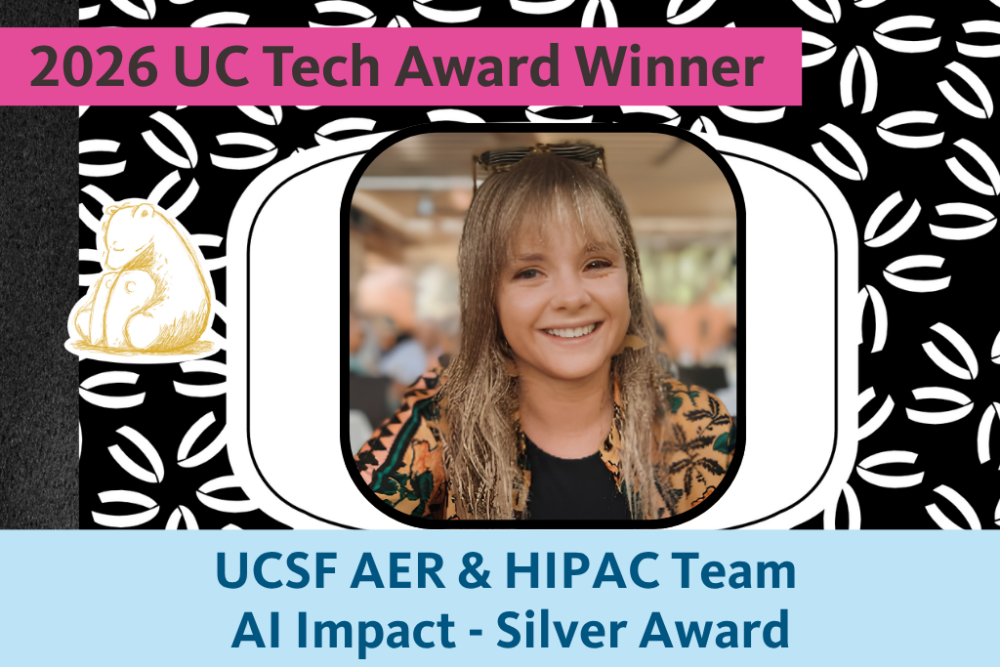
UC Tech News is excited to share the stories of the people and projects behind the winners of the 2026 UC Tech Awards.
Team Name: UCSF APeX Enabled Research (AER) & Health IT Platform for Advanced Computing (HIPAC) Collaboration Team
Award Category: AI Impact
Location: UCSF
Team Members:
- Alina Goncharova, AER Program Manager, Research Informatics, UCSF
- Jory Purvis, AER Technical Lead, Research Informatics, UCSF
- Rick Larsen, Director, Research Informatics, UCSF
- Mark Pletcher, Chair, Department of Epidemiology & Biostatistics, UCSF
- Hossein Soleimani, Director, Data Science & AI, UCSF
- Joanne Yim, Data Engineer, Data Science & AI, UCSF
- Sara Murray, Vice President, Chief Health AI Officer, UCSF Health
The UCSF APeX Enabled Research (AER) & Health IT Platform for Advanced Computing (HIPAC) Collaboration Team won the Silver AI Impact Award at the 2026 UC Tech Awards for creating a first-of-its-kind, governed pathway to embed, evaluate, and scale AI models directly within the Electronic Health Record (EHR), enabling real-world clinical impact at UCSF.
Project Summary
Healthcare AI innovation faces a critical “last mile” challenge: moving models from research into safe, real-world clinical workflows. At UCSF, researchers could develop promising AI models, but there was no standardized, scalable pathway to deploy them within the electronic health record (EHR) for real-time use.
To address this gap, UCSF established a strategic collaboration between APeX Enabled Research (AER) and the Health IT Platform for Advanced Computing (HIPAC), creating an end-to-end, governed pipeline for AI deployment in clinical workflows that spanned the full lifecycle:
Design → Validation → Silent Testing → Pilot/RCT → Enterprise Deployment & Monitoring
The collaboration transformed UCSF’s ability to operationalize AI, enabling translational AI at enterprise scale. While it delivered numerous positive outcomes, the most transformative may be UCSF’s ability to innovate like a research institution while deploying like a health system, bridging a gap that has historically limited AI’s real-world impact.
Alina Goncharova, the team representative, shared some of her thoughts on the project and its impact in the Q&A below.
How did collaboration across teams or campuses shape the project?
This project fundamentally changed how AI Research projects are implemented at UCSF. Historically, the teams operated in separate domains. AER focused on integrating tools and research workflows into Epic, while HIPAC focused on AI infrastructure and deployment. As demand for clinical AI projects accelerated, it became clear that researchers needed a more unified and coordinated experience rather than navigating disconnected technical and governance processes across multiple groups. Building that blended model involved relationship-building, process redesign, and establishing shared ownership across teams with different expertise and priorities. Today, we run joint biweekly meetings with researchers, AER, and HIPAC working toward a shared implementation and validation goals. That collaboration created a more cohesive pathway from early concept development to governed clinical deployment and helped reduce friction for both researchers and operational stakeholders.
Was there any user feedback that stood out and led to a meaningful change in your project?
One theme we heard repeatedly from researchers was frustration with “starts and stops” that often happened during implementation. Different teams became involved at different stages, governance pathways were difficult to navigate, and communication gaps sometimes slowed projects down or created uncertainty about next steps. Some even suggested the need for a “concierge” model to help guide researchers through the process.
That feedback directly shaped how AER and HIPAC collaborate today. Instead of functioning as disconnected technical groups, we focused on building a coordinated service model centered on the researcher experience. Joint planning meetings, shared governance discussions, and stronger cross-team communication helped create a more seamless pathway for deploying and evaluating AI safely within clinical workflows. One of the biggest lessons for us was that operational clarity and relationship-building can be just as important as the technology itself.
How has this project shaped your perspective personally or professionally? What’s something you’re proud of?
This project reinforced that successful AI implementation in healthcare is much more about people, governance, and operational alignment than just the models themselves. Some of the most impactful work involved building trust between teams that historically operated independently and creating shared processes that could support researchers more effectively. One thing we’re especially proud of is helping create a system where innovation and responsible oversight can coexist. The Learning Health System Oversight Committee and Health AI Committee (https://ai.ucsf.edu/oversight) work together to evaluate study design, monitor model performance, and guide implementation decisions throughout a project’s lifecycle. That structure allows UCSF to move AI projects forward thoughtfully while maintaining clinical trust, accountability, and patient safety.
Contact
Alina Goncharova, Technical Program Manager, Research Informatics, UCSF