Almost 70% of UC Tech News survey respondents said that learning more about tech projects being implemented across UC is important to them. In response, we’ve launched the UC Tech Project Series. This story, originally published by UC Santa Cruz on March 3, 2026, is part of that series.
Walking through the redwoods between Science Hill and Cowell College, it’s easy to feel disconnected from the digital world. But beneath trees and winding campus roads lies a massive physical operation. Maintaining the UC Santa Cruz network requires an industrial-scale infrastructure that is just as essential to the university’s daily mission as electricity or water.
“Most people depend on Wi-Fi and assume everything is wireless,“ said Mark Beach, Network Infrastructure Senior Manager. “But wireless is only the last handoff. Behind that is a physical world of glass and concrete that we manage 24/7 so your work stays uninterrupted.“
The Work Behind the Wireless
When you think of Information Technology Services (ITS), you might envision team members at a desk answering support tickets or troubleshooting laptop issues. While that technical support is vital, the reality for much of the Network Infrastructure team is boots-on-the-ground physical labor.
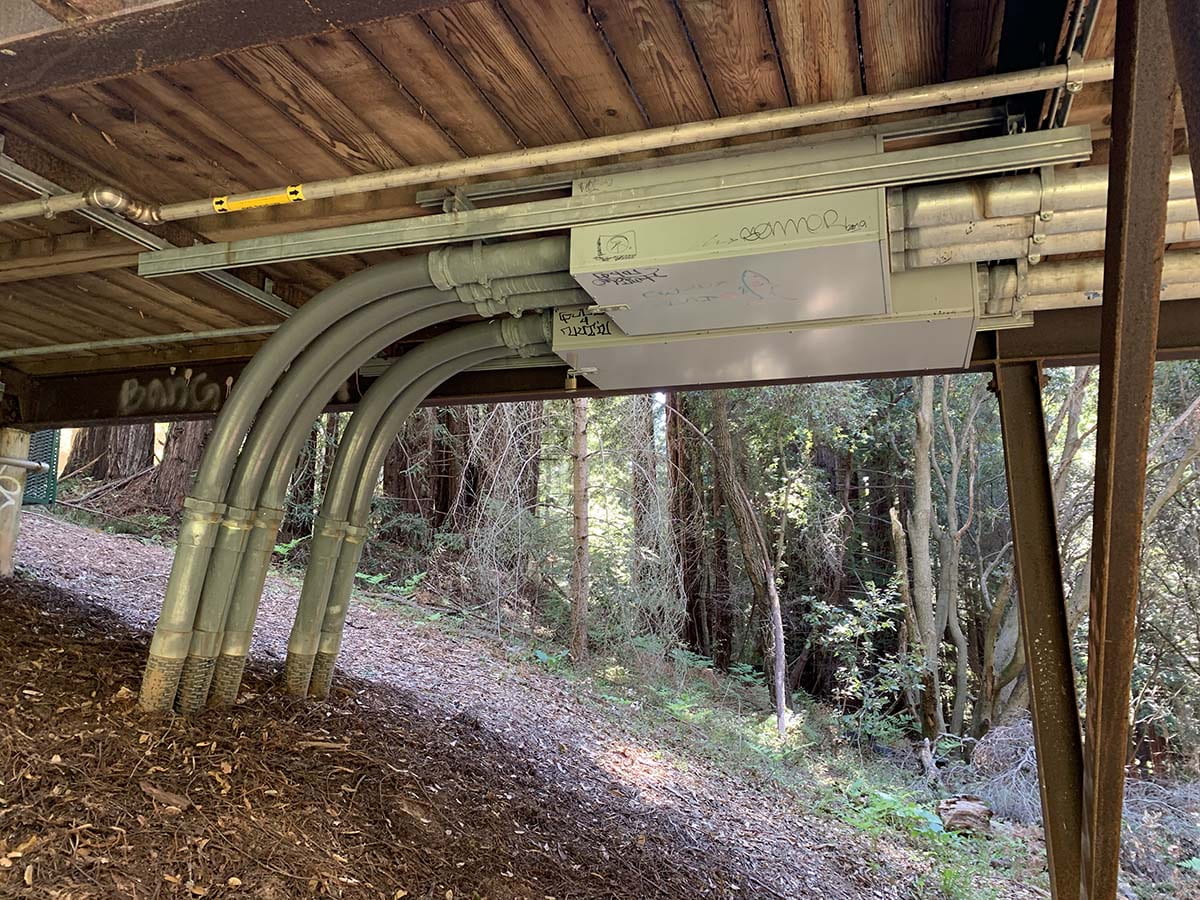
Conduits running under a bridge on campus
Maintaining a network in the redwoods is an industrial-scale operation. On any given day, you may see team members in hard hats navigating steep terrain or lowering ladders into maintenance holes. The work begins at 6:00 a.m., rain or shine, and involves everything from lifting 50-pound equipment boxes into data rooms to pulling miles of new fiber through underground conduits.
“Our technicians are like the fire department of the university,” said Beach. “We have coverage seven days a week. If a switch goes down in a dorm on a Sunday night while 40 students are studying for a final, we’re on it fast. At that moment, they’d rather have the internet working than the lights!”
Beyond responding to emergencies and outages, the team uses proactive monitoring services to catch hardware failures before a student or staff member even notices a dip in service. Often by the time a Service Desk support ticket is even generated, the team is already on-site to swap out the hardware. In addition, the team manages a massive, never-ending cycle of hardware renewal. As technology changes and the campus population increases, technological demands increase as well. The scale of the work has grown exponentially over the years. Where the team once managed 500 wireless access points 15 years ago, they now maintain over 5,000. To keep the network from falling behind the times, the team also refreshes an average of 1,000 devices every single year.
Beneath the Redwoods
While internet connection feels seamless on your screen, the physical reality of UC Santa Cruz is a unique challenge. Unlike a flat city campus, our network lives in some of the most difficult terrain in the state. Miles of fiber optic cable with strands of glass the width of a human hair are threaded through underground conduits that must withstand the elements.
Sue Harden, an ITS Plant Engineer, handles the underground work that makes your digital life possible. Her job involves navigating maintenance holes and concrete vaults that go underground to help manage the fiber and copper infrastructure that connects all of the network equipment.
“This campus is geologically unique,” Harden said. “We deal with sink holes and rain runoff and environmental factors that can damage and disintegrate infrastructure.” When Sue is out in a hard hat checking for toxic gas in a vault or repairing a rusted lid, she is ensuring that a tree root or a mudslide doesn’t cut off your access to a midterm or a research deadline.

The Network by the Numbers
Managing a network across 2,000 acres of rugged terrain requires a massive amount of physical hardware and constant upgrades. Here is a look at the infrastructure behind the connection:
- 450 Buildings: The number of campus structures currently linked by a matrix of underground fiber.
- 5,000+ Access Points: These are the devices that look a bit like smoke detectors on the ceilings in classrooms and dorms that deliver wireless internet to your devices.
- 400 Gigabits: The capacity of our primary internet connections, currently being quadrupled from 100GB to ensure the campus stays stable during peak hours.
- 1,200+ Device Connections per Hall: In a single large lecture hall, it’s common for 300 students to carry multiple “unique connections”: a laptop, tablet, phone, watch, all sharing a signal simultaneously.
Building for the Future
As the university grows, the network team is already building the foundation. The Engineering and Construction Management (ECM) team designs the infrastructure for new buildings years before the first student moves in, managing millions of dollars in equipment to ensure the campus stays ahead of the curve.
This meticulous planning ensures that as the student population increases and technology demands change, the physical backbone of the university is ready to support it. From projecting fiber needs for future residential spaces to calculating the equipment requirements for the next generation of research facilities, the team works behind the scenes to ensure that when a new building opens its doors, the network is ready to go.

The constant physical upkeep performed by the network team is what keeps the university’s digital life moving. While the infrastructure remains hidden beneath the forest floor, seamless connectivity is the direct result of a dedicated team navigating the miles of beautiful campus all around us. From a critical research breakthrough or a midnight study session to a simple FaceTime call home, the underground maze of fiber and glass provides the invisible foundation for every digital connection made here.
Read the original story on the UC Santa Cruz Information Technology Services site.
Contact
Cheyenne Matthews-Hoffman
Content Strategist
Experience Strategy & Design, ITS
University of California, Santa Cruz