Digital transformation across the University of California is not just about tools and systems—it’s about people. It’s about the lived experiences, motivations, and commitments of those who shape the future of teaching and learning.
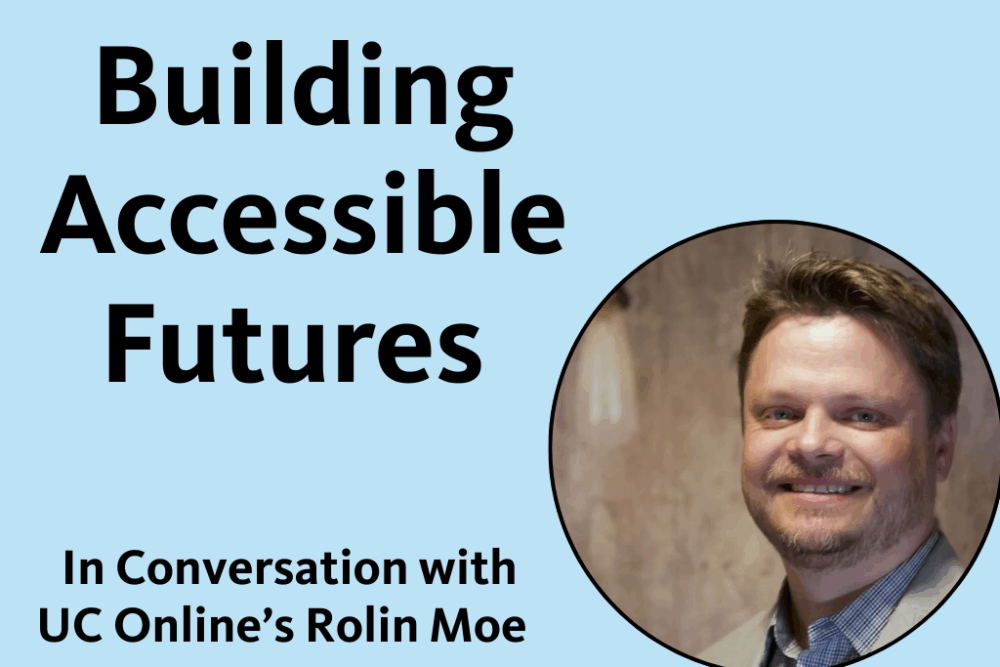
In a recent conversation with Rolin Moe, Associate Vice Provost for UC Online (part of Graduate, Undergraduate and Equity Affairs in UCOP Academic Affairs), we explored the human story behind the systemwide push toward accessible, equitable digital learning. Moe’s reflections illuminate why UC’s digital future must be grounded in access, empathy, and collaboration.
A Non‑Linear Path into Educational Leadership
Before working in higher education, Moe spent years teaching in K–12 schools—including a school in Los Angeles dedicated to students with learning disabilities. That experience became foundational to his understanding of accessibility.
But the connection goes deeper. Diagnosed with ADHD and dysgraphia as a child, Moe remembers being handed a computer in the 1980s and told that technology alone would “fix” his learning challenges. It didn’t. Instead, he had to become his own advocate—teaching teachers how to support him and learning how to work around systems that were not designed for neurodiverse students.
“I spent my whole school career building accommodations for myself,” he shared. “That shaped everything I do now.”
Even after pursuing graduate study in film—his first academic discipline—Moe kept being pulled into roles that involved academic digital strategy and systems thinking. The pattern eventually pushed him toward doctoral studies at Pepperdine, where he examined educational technology and research through a more formal lens.
Those experiences eventually led him into leadership roles in the California Community Colleges system, including guiding district‑wide distance education initiatives just before the COVID‑19 pandemic rapidly transformed teaching and learning.
UC Online: Harnessing the Power of Ten
At UCOP, Moe’s work sits within Graduate, Undergraduate and Equity Affairs (GUEA), where UC Online supports degree‑seeking students and campus digital learning efforts across the system.
He describes UC Online’s mission this way:
“Our role is to amplify digital education—to support campus goals, system goals, and the broader digital learning ecosystem by harnessing the power of ten.”
This work extends far beyond traditional “online courses.” It involves:
- Facilitating cross‑campus digital education collaborations
- Strengthening infrastructure and digital operations
- Supporting innovation emerging from UC campuses
- Helping faculty navigate shifts in pedagogy, assessment, and technology
Moe sees the UCOP’s “Informational Technology Services” (ITS) department shift to “Digital and Information Technology” (DigIT) as an important symbolic realignment.
“Digital isn’t just a modality,” he said. “A virtual meeting can be deeply human, while an in‑person one can be completely transactional. What matters is intentionally designing for connection.”
Accessibility as Personal Mission and Institutional Priority
For Moe, accessibility is both personal and professional. His early experiences navigating education without adequate structural support for neurodiversity shaped his sense of duty. And today, as accessibility requirements evolve—particularly with the upcoming WCAG updates—he sees an urgent need to expand UC’s commitment to inclusive design.
But he worries that fear—fear of change, fear of compliance obligations, fear of shifting student expectations—can push institutions into retreat.
“This is not the time to close ranks,” he emphasized. “Just because accessibility feels new or hard doesn’t mean we can go back to old habits. Those habits weren’t working for many of our students.”
Accessibility, he argued, supports everyone—not just students with diagnosed disabilities. It supports English‑language learners, working students, low‑bandwidth households, neurodiverse learners, and anyone managing complexity in their lives.
He praises grassroots efforts at UCOP—such as accessibility champions programs created by staff like Judy Thai—and hopes to see similar initiatives flourish systemwide.
Partnering with LinkedIn: Just‑In‑Time Learning for Educators
Another major thread of Moe’s work involves developing micro‑learning content alongside LinkedIn Learning.
Years ago, LinkedIn launched an initiative to support campus instruction with supplemental materials. Moe built a course on quantitative research—designed to address the “15 core concepts” students often struggle with. At first, engagement was low. But years later, faculty worldwide began incorporating the course into curricula, and it remains widely used almost a decade later.
This experience confirmed the value of asynchronous, modular, just‑in‑time learning for educators and professionals.
More recently, Moe has developed courses on AI literacy and a new accessibility micro‑course, launched just days before our conversation. He is now collaborating with UC leadership on a UC‑exclusive webinar tentatively titled: Accessibility for the LMS in Under an Hour.
Practical Accessibility – Canvas LMS
Accessibility for the LMS in Under an Hour
March 25, 2:00-3:00 pm PT
The session will give UC faculty practical, hands‑on guidance aligned with upcoming accessibility standards—without directing them to external commercial content. You must register and sign-in using a UC email address.
Registration: https://UCOP.zoom.us/meeting/register/rs3o0KvhR9S68kXCpWpJug
Accessibility for the LMS in an Hour is a practical, design-focused webinar for anyone building or teaching courses in the UC system that utilize Canvas, our shared learning management system. In under sixty minutes, we’ll cover what it actually means to create an accessible LMS course without turning you into a legal expert or a developer. You’ll learn how accessibility shows up in everyday decisions like page structure, documents, media, navigation, and assessments, and how small, intentional changes can make a big difference for learners. While accessibility regulations are evolving, this session focuses on what works now: clear design, inclusive practices, and strategies you can apply immediately in the tools you already use.
Facing Fear, Embracing Innovation
Moe also addressed the broader moment higher education is currently experiencing. Institutions are navigating cuts to research funding, operational constraints, heightened public scrutiny, and the rapid adoption of AI.
All of this contributes to uncertainty—and in uncertainty, fear often fills the gaps.
The presence of AI doesn’t diminish the value of consideration, curiosity, or creativity, noted Moe. Instead, it challenges us to redesign assessments to reinforce those skills. Accessibility, once again, becomes a foundational lens: if assessments are flexible, inclusive, and student‑centered, they’ll naturally be more resilient to technological change.
A Vision for UC’s Digital Future
It is clear that for Moe, digital transformation is ultimately about human possibility. His work sits at the intersection of systemwide coordination, personal experience, and educational equity—and it reflects a deep belief in what UC can accomplish when campuses collaborate with intention.
He sees UC Online not as a centralized content factory, but as a connector—a place where expertise from across the system can be woven together to create a more inclusive digital future.
“Education is about introducing people to things they don’t yet know they love,” he said. “My job is to help build systems that make those experiences accessible—to everyone.”
Contact

Rolin Moe
Associate Vice Provost for UC Online