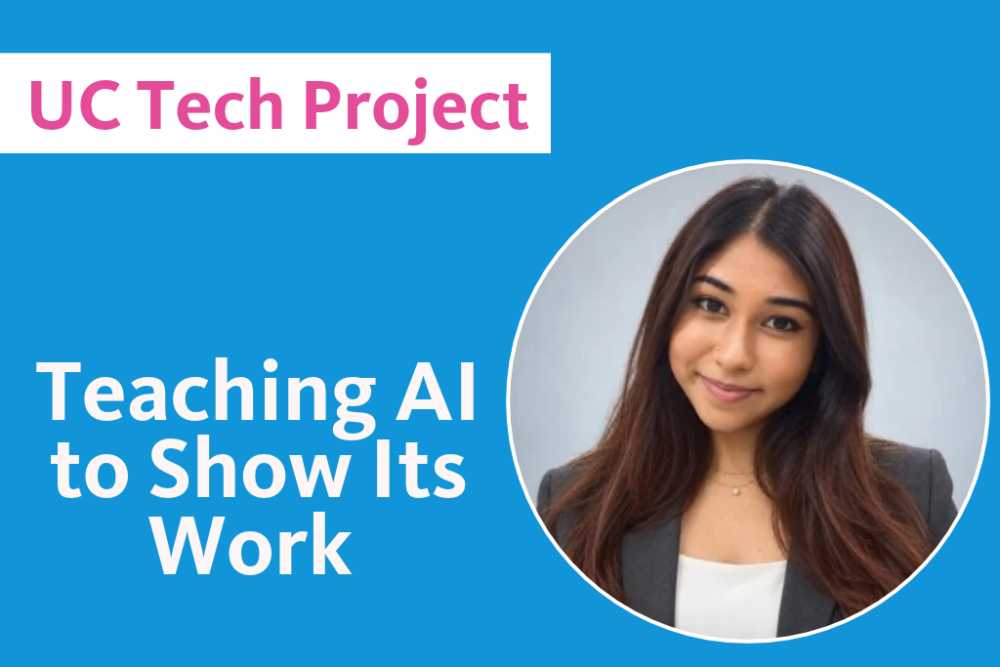
As scientific literature grows faster than any researcher can read, AI tools promise to help—but large language models are notorious for generating confident-sounding claims with fabricated or unverifiable citations. Kora Dey, a UC LEADS Scholar at UC Riverside mentored by Dr. Haofei Zhang, set out to fix that.
Kora’s project, ResearchBase AI, is a retrieval-grounded research platform that combines hybrid search, multi-model “AI jury” reasoning, self-critique, and a built-in hallucination guard to ensure every claim an AI makes is traceable back to peer-reviewed evidence.
From a Chemistry Tool to a Cross-Disciplinary Platform
ResearchBase AI didn’t start out as the ambitious, multi-layered system it is today. It began as a simple search engine for Dr. Zhang’s publications in AI for chemistry. But while building it, Kora noticed something bigger at play.
“While building it, I saw that the central challenge of getting AI to retrieve the right evidence and cite it accurately wasn’t a chemistry problem,” she says. “It’s one of the biggest unsolved problems in AI-assisted research. The AI tools meant to help often produce confident answers built on citations that can’t be verified or that don’t exist at all,” Kora explains. “In research, where accuracy is everything, that’s a fundamental barrier to trust.”
That realization led her to re-engineer the project from the ground up into a cross-disciplinary research platform, combining hybrid search, multi-model AI reasoning, a scientific knowledge graph, and built-in safeguards against fabricated citations. Her vision was to create a tool that researchers, graduate students, and undergraduates could rely on for fast, reliable answers amid an ever-growing volume of scientific literature. The goal: turn AI from a fast-talking black box into a research collaborator scientists can actually trust.
What began as a tool for chemistry research has since expanded to include biology, climate science, AI, policy research, and environmental science. She developed it through the UC LEADS program at UC Riverside under Dr. Zhang’s mentorship and presented it at UC Tech 2026.
Putting It to the Test
To see whether the approach actually worked, Kora built a rigorous, multi-layered evaluation with numerous tests.
- More than 1,000 students compared ResearchBase AI side by side with ChatGPT, Claude, and Gemini, and consistently rated it as more reliable, more relevant, and easier to verify.
- She also ran head-to-head benchmarking, posing identical research questions across biology, climate science, AI, policy research, and environmental science to ResearchBase AI and the leading general-purpose assistants. The pattern was consistent: general-purpose tools tended toward broad, unsourced answers, while ResearchBase AI cited real publications and named specific methods and findings.
- In real-world case studies—such as identifying the most effective methods for Alzheimer’s disease detection—the platform surfaced leading approaches, summarized where studies agreed, and quantified the strength of that agreement.
- It also cross-checked every answer against the consensus of retrieved studies to confirm its claims were grounded in published evidence rather than simply sounding plausible.
- Compared with a baseline AI model, ResearchBase AI reduced hallucinations by 87% and achieved 100% citation traceability. Every claim links to a real, verifiable publication.
“AI doesn’t have to choose between being powerful and being accountable,” Kora says. “These results are driving the next phase of development.”
Those results come from a carefully engineered system. Here’s a closer look at how ResearchBase AI works under the hood.
The Full Picture: How ResearchBase AI Works
ResearchBase AI uses a multi-layer architecture that integrates scientific literature retrieval, evidence evaluation, multi-model reasoning, structured knowledge representation, and research decision support. Rather than treating an AI model as the sole source of information, the framework separates scientific evidence retrieval from the reasoning process and incorporates multiple verification mechanisms before presenting a final response.
1. Building a Scientific Knowledge Foundation
The first component focuses on collecting and organizing scientific literature into a searchable research knowledge base. Research papers are processed using document-parsing tools such as GROBID—which converts research paper PDFs into structured, searchable text—and PyMuPDF, extracting scientific text and relevant metadata, including publication titles, authors, journal information, and digital object identifiers (DOIs).
The system then organizes this information through citation indexing, scientific entity normalization, and vector embeddings, identifying relationships between publications based on their scientific content. This creates a foundation in which AI-generated responses can be connected to published research rather than relying exclusively on information stored within a language model.
2. Intelligent Scientific Literature Retrieval
At the center of the platform is a hybrid search system that combines BM25 + Sentence-BERT, pairing exact keyword matching with meaning-based search to surface the most relevant evidence. Traditional keyword search can be effective when researchers know exactly what terminology to use, but it may overlook relevant studies that describe similar concepts using different language. By contrast, semantic search can recognize conceptual similarities but may miss exact technical terminology or specific methodological details.
ResearchBase AI combines both: Sentence-BERT embeddings for semantic similarity, BM25 for keyword-based retrieval, and FAISS for efficient vector indexing. Transformer-based Cross-Encoders then rerank the results to identify the sources most relevant to the research question, which is especially useful for interdisciplinary research where related findings appear across fields under different terminology.
3. Scientific Reasoning and Evidence Verification
Once the system retrieves relevant literature, it uses retrieval-augmented generation (RAG) to produce responses grounded in that evidence, rather than generating explanations primarily from its own training. The reasoning framework supports tasks including:
- Synthesizing findings across multiple scientific publications
- Identifying areas of agreement and disagreement between studies
- Evaluating whether published evidence supports, contradicts, or is insufficient to establish a scientific claim
- Recommending statistical methods, experimental approaches, and analytical techniques based on relevant literature
- Identifying limitations, unanswered questions, and potential gaps in existing research
A key part of this process is evidence-aware confidence assessment—rather than treating every response as equally reliable, the system weighs retrieval relevance, evidence quality, citation coverage, and agreement across publications. When literature is incomplete or conflicting, it’s designed to communicate uncertainty instead of presenting unsupported conclusions as fact.
4. Multi-Model “AI Jury” and Self-Critique
What distinguishes ResearchBase AI from a conventional retrieval-augmented chatbot is its multi-model reasoning architecture, also known as the “AI jury.” Several leading AI models (GPT-4o, Claude, and Llama) independently analyze the same retrieved evidence. Their conclusions are then compared to identify agreement, conflicting interpretations, and uncertainty, much like peer review, with a consensus-based process synthesizing these perspectives into a single evidence-grounded response.
The system also incorporates self-critique: before finalizing an answer, it audits its own reasoning, re-checking for unsupported claims, missing citations, or logical gaps. Combined with a hallucination guard—which ensures the system says so when evidence is insufficient or conflicting, rather than inventing an answer—these mechanisms are designed to reduce the likelihood of confidently presenting inaccurate information.
5. Scientific Knowledge Graphs and Research Memory
Scientific research rarely exists in isolation—findings build on earlier studies, methodologies evolve across disciplines, and relationships between papers can reveal patterns that are hard to spot through conventional searches. ResearchBase AI addresses this with a knowledge graph: a connected map of research showing how papers, authors, methods, datasets, and findings relate to one another.
For example, a researcher investigating a particular biological process could use these relationships to explore which experimental techniques have been applied to similar problems, where studies disagree, and which areas remain insufficiently investigated—moving beyond retrieving individual documents toward understanding the broader structure of scientific knowledge.
6. Supporting Scientific Discovery and Research Decisions
ResearchBase AI brings together capabilities typically handled by separate research tools, supporting any discipline grounded in peer-reviewed literature:
- Evidence-backed answers — every claim links directly to the study it came from
- Knowledge graph mapping — how papers, authors, methods, datasets, and findings connect across a field
- Real-time citation tracking — following which papers support each claim as new research comes in
- Consensus mapping — showing where studies agree, disagree, or remain mixed
- Method recommendations — suggesting methods, datasets, and analytical approaches drawn from published work
- Research gap detection — pinpointing understudied areas and open questions
- Confidence scoring — rating each answer on evidence quality, citation coverage, and agreement across sources
Evaluation and Research Significance
A central part of the project has been investigating whether combining scientific retrieval, evidence verification, and structured reasoning can reduce the hallucination problems commonly associated with large language models. In project evaluation, ResearchBase AI demonstrated an 87% reduction in hallucinations, supporting the potential value of layering additional evidence-grounding and verification mechanisms into AI-assisted scientific workflows.
But for Kora, the larger research question extends beyond a single metric: how do different retrieval strategies, reasoning architectures, and evidence evaluation methods influence the reliability of AI-generated scientific conclusions? And more broadly, how should AI systems represent uncertainty and communicate conflicting evidence without encouraging researchers to over-rely on automated answers?
Future Directions
ResearchBase AI is currently a fully functional prototype in an active cycle of testing and refinement and is not yet publicly available. Each evaluation round directly shapes the next iteration of its retrieval, reasoning, and citation safeguards, as Kora continues to expand the range of research questions it can handle.
Looking ahead, Kora is focused on:
- Expanding knowledge graph-based retrieval and cross-publication evidence evaluation
- Developing more sophisticated approaches to scientific consensus modeling
- Studying how researchers interact with and trust AI-generated recommendations
- Applying these methods across disciplines, especially where scientific information is complex, rapidly evolving, or widely distributed
“Ultimately, my goal is to contribute to AI systems that do more than produce convincing answers,” Kora says. “I want to help develop systems that can demonstrate why an answer is credible, recognize when evidence is insufficient, and support researchers in asking better questions.”
Contact

Kora Dey
UC LEADS Scholar
University of California, Riverside
UC Tech Project Series
View UC Tech stories here.
Tell us about the tech project you or your team has completed, is working on, or is preparing to work on. Your story, if accepted for publication, will be shared out on the UC Tech News site, in the UC Tech News newsletter (room/timing permitting), and on the UC Tech News LinkedIn page. Please use the UC Tech News blog intake form to submit your UC Tech Project story: https://app.smartsheet.com/b/form/be650a2cf625471684bd94d18122d17b