Published in honor of Women’s History Month with an introduction by Teri Eckman, Executive Director, Student Information Systems, UC Riverside
It’s Women’s History Month, anchored by two dates I think about every year: International Women’s Day (March 8) and Equal Pay Day (March 26). More than milestones, they’re gut checks — reminders that while we’ve come far, we are still very much in the fight.
I recently saw Suffs, Shaina Taub’s Broadway musical about the “feisty and strategic” women who fought for the 19th Amendment. I went with my friend and our teenage daughters, which made the whole experience hit differently. Watching it was complicated. Hard, honestly — because you could swap the historical names for modern ones and find us still having the exact same arguments about systemic bias and representation. A century later.
But then came the moment that made the whole night worth it. After a particularly powerful scene, I glanced over and saw tears on my 13-year-old’s face. She got it. She understood, in a way that words hadn’t quite conveyed before, that this fight isn’t historical — it’s ongoing, and it will one day be hers to carry. The play’s message is clear: progress is possible, not guaranteed. It will only be made if we keep marching.
In that spirit, we reached out to leaders across the UC system to ask how we can keep marching within our own institution. This year’s IWD theme, “Give to Gain,” feels especially resonant — the idea that when we share knowledge and lift others up, we multiply opportunities for everyone.
Interviews by Francesca Albrezzi, PhD, UCLA Office of Advanced Research Computing
Francesca Albrezzi brings technical expertise, grace, and a steady presence that has long made her a connector and champion within the UC community. She recently co-authored The Digital Humanities Coursebook: Applied Concepts and Critical Approaches (second edition), and for seven years has co-chaired UCLA’s XR Initiative, guiding cross-campus collaboration and cultivating an inclusive community around emerging technologies. She connected with UC women leaders this month to ask questions regarding their expertise as it relates to our UC WIT community.

Patricia Juárez, Senior Business Systems Analyst, University of California, Berkeley
For women in IT whose career growth feels ‘on ice,’ what is one concrete way they can use UC’s transparency tools to position themselves for an equity adjustment or reclassification the moment the budget ‘thaws’?
Go beyond the tools and embrace the heart of “Give to Gain”: elevate each other, especially women of color. As the ARiA (Anti-Racism in Academia) team describes it, this means raising up Black, Indigenous, and People of Color (BIPOC) colleagues through public and private praise, nominations for awards, citations, recommendations, amplification, and celebration. This isn’t about recognition without merit — it’s about countering the very real “invisibility” women of color experience day-to-day. By lifting those at the bottom of the ladder, we rise together.
How can womxn in IT best document their efforts to ensure recognition as a strategic asset?
Documentation requires energy, strategic framing, and resilience. Key approaches: keep detailed performance evaluations that capture all contributions; collect mini-testimonials from colleagues, users, and vendors; maintain a projects portfolio tracking goals and impact; write business cases documenting problems, approaches, and outcomes; and send regular stakeholder updates that highlight the importance of your deliverables. In everything — quantify impact and align your work to UC’s mission.
What does “keep marching” look like right now — and what is one concrete thing to do this month?
As one of the few — if not the only — Native Indigenous woman in my IT department, I’ve always been in “keep marching” mode. I’ve been in IT since 1990, and the structures have always required double or triple the effort just to prove I belong. What’s different now is that this mode seems shared by many, not just those of us who have navigated it for decades.
My one concrete piece of advice: take care of yourselves. Take deep breaths. Give yourself permission to be compassionate — with yourself and with others. Read poems. Laugh. Cry. Talk to your sisters, daughters, and mothers. You are full, complex, and beautiful human beings. Embody that fully.

Laura Kray, Professor, Management of Organizations, The Ned and Carol Spieker Chair in Leadership, Haas School of Business, UC Berkeley
Your 2024 research shows women are asking for more but not receiving the same outcomes as men. What does that tell us about where the pay gap conversation needs to go?
Our research overturns one of the most stubborn myths: that women don’t ask. Among MBA graduates, women were actually more likely than men to have negotiated their job offers — 54% versus 44% — yet they were turned down more often and still earned significantly less. The pay gap is not a negotiation propensity gap. It is a “women ask but don’t get” problem.
Organizations need to invest in transparent pay bands, structured salary review processes, and accountability for managers whose offers diverge by gender. Keeping the “women don’t ask” myth alive shifts responsibility onto women and away from the institutions that control outcomes — and our research shows it directly reduces support for structural remedies like salary history bans.
What does behavioral science say actually works in salary and promotion conversations — and what might be backfiring?
What works: ask what the employer needs from this role, listen carefully, and pitch yourself as the answer. Curiosity builds trust. Framing your ask around shared goals rather than personal gain also reduces the social penalties women can face for self-advocacy. What may be backfiring: generic “lean in” messaging. When the pay gap is framed as a problem of women’s assertiveness, it reduces support for the structural interventions — pay transparency, salary history bans — that the evidence actually supports.
What is one concrete thing womxn in IT should do this month?
Insist on evidence, not assumptions, about how your workplace operates. In IT environments — where compensation is highly negotiated and equity benchmarks are available — there is no justification for failing to track whether men and women receive comparable offers for comparable work. Staff and faculty at research universities are exceptionally well-positioned to demand salary transparency. That’s the action for this month.

Catherine J. Weinberger, Independent scholar, University of California, Santa Barbara Department of Economics, Broom Center for Democracy, and Institute for Social, Behavioral and Economic Research
The data on women entering STEM has improved, yet pay gaps persist long-term. What does the economic evidence tell us about why early progress isn’t translating to pay parity over a career?
My earlier research (spanning 1985-2006) found substantial racial and gender gaps in earnings within a year of college graduation, even conditional on college major, grades, and the exact college attended. Later, I discovered that the rate of earnings growth over the course of a career is similar for women and men. This pattern was evident whether I followed individual women or full cohorts of women over time. That led to the conclusion that most of the change in the gender earnings gap over time is due to younger cohorts of women entering the labor market with more opportunities than were possible for women born in earlier generations.
The plot below describes the average gender earnings gap faced by full-time, full-year workers in different segments of the workforce, using data collected by the U.S. government between 2009 and 2024. To ensure meaningful comparisons, I chose to compare the pay of each woman to that of men observed the same year and who were born in the same U.S. state at about the same time (within 5 years). In this figure, the gender gap estimate for each birth cohort is in a different color. The estimates are presented for five different segments of the workforce: 1) the entire workforce, 2) all college graduates, 3) the subset with majors in Computer Science, Computer Engineering or Electrical Engineering, 4) graduates with those three majors who are employed on college and university campuses in non-instructional roles (and are not enrolled), and 5) graduates with any major who are employed on college and university campuses in IT occupations (and are not enrolled).
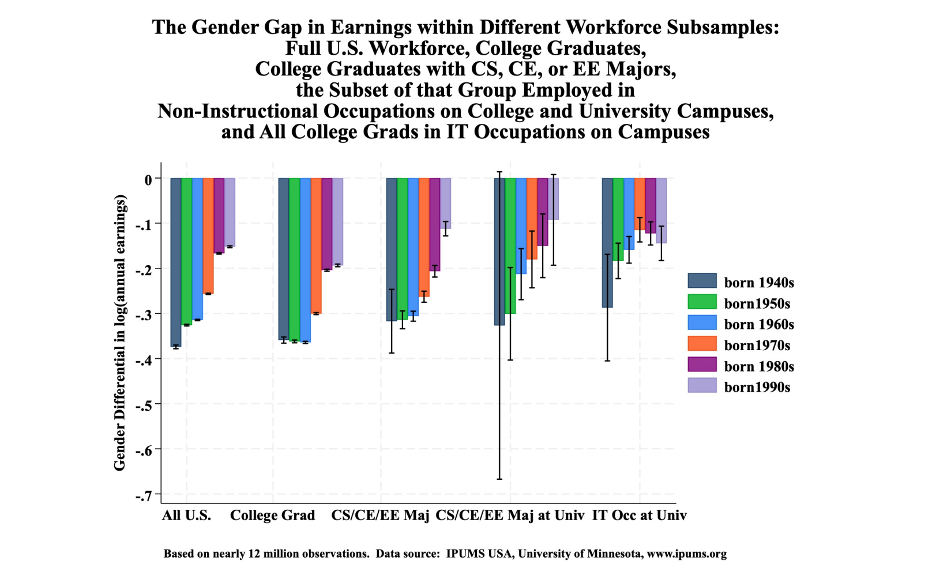
Figure Notes: Bar chart estimates represent the average differential in log annual earnings when comparing women to men who are in the same 5-year age group and were born in the same U.S. state. All samples are drawn from the American Community Surveys 2009-2024, restricted to currently employed individuals at least 23 years old who worked full-time, full-year last year and were born in the U.S. no earlier than 1940. Sample size is nearly 12 million for the full workforce, with more than 5 million college graduates, 283,259 who majored in computer science, electrical engineering, or computer engineering, 6,950 of the preceding group employed at colleges and universities in non-instructional occupations and not enrolled, and 19,860 college graduates (with any major) employed at colleges and universities in IT occupations and not enrolled. Error bars represent 95% confidence intervals.
The figure illustrates that, in each subsample, gender gaps are smaller for the younger cohorts, and also displays a striking similarity between the first four subsamples of the workforce, although the estimates for the smaller subsamples are (of course) noisier. Adding controls for factors associated with higher compensation — like higher degrees or working long hours — have little effect on the estimates. This is because men and women are about equally likely to have these characteristics. The fifth subsample, which includes only IT workers employed on college or university campuses, exhibits a somewhat smaller but still substantial set of gender gap estimates. Conditional on observable skills and traits, lower pay for women, and particularly for older women, is ubiquitous in our society and is not caused by something a particular person did or did not do.
What does “keep marching” look like for womxn working in IT at a research university right now — and what is one concrete thing you would tell them to do this month?
Employment in IT careers can be isolating for women. If you can find the time, I find it helpful to read about the experiences of others, particularly women scientists of earlier generations (see list below). Also, the emerging body of behavioral experiments designed to inform institutional policies that foster both equity and productivity is very inspiring (e.g., What Works: Gender Equality by Design and Make Work Fair: Data-Driven Design for Real Results).
Recommended Readings About Women Scientists:
- Monosson, Emily. 2010. Motherhood, the Elephant in the Laboratory: Women Scientists Speak Out. Ithaca, N.Y.: Cornell University Press. https://doi.org/10.7591/9780801459078.
- Gornick, Vivian. 1983. Women in Science: Portraits from a World in Transition. New York: Simon and Schuster.
- Rich, Adrienne. 1977. Working It out: 23 Women Writers, Artists, Scientists, and Scholars Talk About Their Lives and Work. Edited by Sara Ruddick and Pamela Daniels. 1st ed. New York: Pantheon Books.
- Keller, Evelyn Fox. 1983. A Feeling for the Organism: The Life and Work of Barbara McClintock. 10th anniversary ed. New York: Henry Holt.
Recommended Readings About Science and Gender:
- Margolis, Jane and Allan Fisher. 2002. Women in Computing: Unlocking the Clubhouse. MIT Press.
- Schiebinger, Londa. 1999. Has Feminism Changed Science? Cambridge: Harvard University Press.
- McIlweee, Judith S. and J. Gregg Robinson. 1992. Women in Engineering: Gender, Power, and Workplace Culture. Albany, New York: State University of New York Press.

Molly Greek, Chief Information Officer (CIO), UC Office of the President (UCOP)
What levers are most powerful for moving toward pay equity across UC’s technical workforce?
UC already has several structural advantages I haven’t seen elsewhere: an annual equity review performed by HR in partnership with department leadership, publicly reported salaries, structured recruitment practices, and a systemwide commitment to a diverse and equitable workforce as a core value. Pay transparency and HR practices aimed at equity are genuinely important — the infrastructure to identify and address gaps is there.
What can women in IT do to advocate for themselves on pay and promotion?
Start with a direct conversation with your manager. Let them know if you feel your pay isn’t equitable or that you’re ready for advancement. Learn what’s available: equity reviews, reclassifications, temporary assignments, open positions. And don’t limit yourself to your current campus — the UC system as a whole offers far more opportunities than any single location. Don’t wait years for something to open nearby.
What is one concrete thing womxn in IT should do this month?
Figure out what’s holding you back and take action. Is it confidence? Skills? Experience? Opportunities? Ask your manager or trusted colleagues for honest observations. Then move: pursue a stretch assignment, take a course, meet someone for coffee, join an ERG. The point is to act — not wait.
What We Carry Forward
Across very different vantage points, a consistent message emerges: the structural barriers are real, and waiting for them to move on their own is not a strategy. What these leaders share is a belief that change requires both collective action and individual intentionality. Elevate others, document your value, demand transparency, and don’t stay still. Progress is possible. But only if we keep marching.
Key actions from this conversation:
• Elevate women of color around you — through nominations, praise, citations, and amplification. This is the most concrete form of “Give to Gain.”
• Document your value strategically: performance reviews, mini-testimonials, project portfolios, and business cases that quantify your impact and align to UC’s mission.
• Have the conversation with your manager — about pay equity, advancement readiness, or both. Don’t assume they know, and don’t wait for them to ask.
• Push for pay transparency. Use UC’s public salary data to benchmark your role, and ask whether comparable positions receive comparable offers.
• Acknowledge systemic “legacy” gaps. Understand that long-term pay gaps are often a result of lower entry points for older cohorts rather than a lack of individual skill or effort. This structural reality reinforces the need for collective advocacy over individual “leaning in.”
• Combat isolation with “paper mentors.” When your environment feels isolating, seek out the histories and stories of women scientists and IT pioneers who navigated similar structures. Understanding of the past can provide a clearer blueprint for navigating the present.
• Take one concrete step this month — a stretch assignment, a course, a coffee with someone you admire. And take care of yourself. Sustaining the march requires protecting your energy, your health, and your joy.
Thank you to Patricia, Laura, Catherine, and Molly for their time and candor — and to Francesca Albrezzi and Teri Eckman for bringing these conversations to life. Learn more about California pay transparency at: https://ucnet.universityofcalifornia.edu/compensation/compensation-guidelines/pay-transparency/.
If you are looking for a way to get involved with UC Womxn in IT please email the Executive Committee: Mai Vang (Chair) maiv@ucr.edu, Taura Gentry-Kelso (Co-Chair) tsgentry@health.ucsd.edu, and Yoshita Mukherjee (Communications Chair) ymukherjee@berkeley.edu.